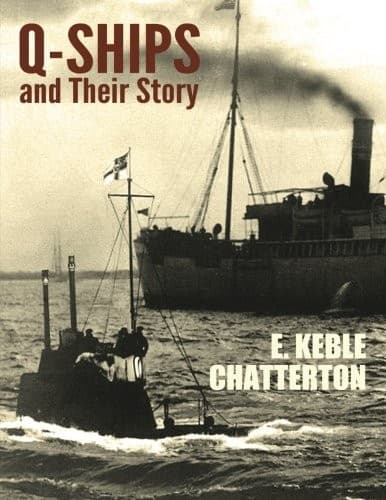
Q-Ships and Their StoryChatterton, E. Keble (Edward Keble)
History
Q-Ships and Their Story
Chatterton, E. Keble (Edward Keble)
Q-ships; World War, 1914-1918 -- Naval operations
Another trying incident was that which occurred to the 1,295-ton
steamer _Mavis_ (alias Q 26 and _Nyroca_), armed with a 4-inch and two
12-pounders. This vessel had been fitted out at Devonport, her Merchant
Service cranes being landed and replaced by dummy derricks. The hatches
to her holds were plated over, access to the same being provided by
manholes. In order to give her the maximum chance should she ever be
torpedoed, she was ballasted with closely packed firewood; and only
those who have seen torpedoed ships carrying a cargo of timber can
realize for what a long time such an apparently sinking ship will keep
afloat, though necessarily deep in the water. I remember, during the
war, the case of a steamer torpedoed off Brow Head (south-west Ireland)
after she had just arrived from across the Atlantic. She was deserted
by her crew, the sea was over the floors of her upper-deck cabins, and
she was obviously a brute to steer in such an unseaworthy condition,
but with great difficulty and some patience we managed to tow her
into port, where, owing to her sinking condition, she drew so much
water that she touched the ground every low tide. But she was salved
and eventually patched up. It was her timber cargo which had kept her
afloat just long enough, and inasmuch as ship and freight were worth
no less than £250,000, this was more than worth while. So it was with
_Mavis_.
On the last day of May, 1917, under command of Commander Adrian Keyes,
R.N., this Q-ship had left Devonport to cruise in the Atlantic. At
6.45 a.m. on June 2 she sighted a ship’s lifeboat coming along under
sail and found it contained three men who were in a very exhausted
condition. These were the survivors from the Greek S.S. _N. Hadziaka_,
which had been torpedoed and sunk a little further to the westward.
This torpedoing had occurred in a heavy sea, and in lowering away the
boats, one of them had been smashed and the other swamped. The captain
and twenty-two men had clung to the wreckage when the German submarine
broke surface, approached, but made no attempt at rescue, and then went
away. For forty-eight hours these wretched men kept more or less alive
in the water and then gradually dropped off one by one until only three
remained. These then managed to patch one boat, upright her, bale her
out, and make sail. They had been sailing for ten hours during the
night when they had the good luck to be picked up by _Mavis_, having
been fifty-eight hours without food or water.
Public-domain text, read in full here on John Shaqi.
Reviews
Reviews
No reviews yet
Be the first to share your thoughts on this work.
Elsewhere in the archive
Join the Discussion
Join the discussion
Sign in to leave a comment or review.
Sign InorCreate an account