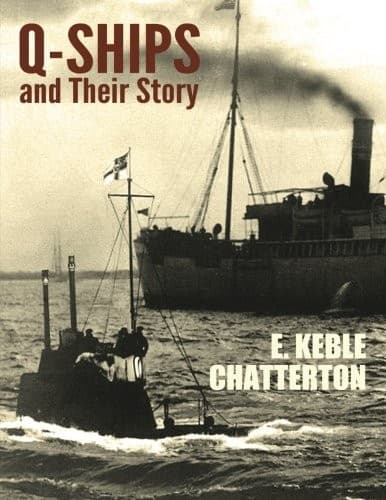
Q-Ships and Their StoryChatterton, E. Keble (Edward Keble)
History
Q-Ships and Their Story
Chatterton, E. Keble (Edward Keble)
Q-ships; World War, 1914-1918 -- Naval operations
Having rescued them, _Mavis_ continued on her western course, but
after dark turned east, setting a course to pass 10 miles south of
the Lizard. During the following day she passed through considerable
wreckage. At 9.45 p.m. she was 20 miles south of the Wolf Rock when
a torpedo was seen to break surface 40 yards from the ship on the
starboard beam. It struck _Mavis_ abreast of the engine-room and
penetrated the side, so that the ship stopped at once, and both
engine-room and boiler-room were flooded. It was impossible to send out
a wireless call, as the emergency apparatus had been wrecked too, but
three rockets were fired and eventually the destroyer _Christopher_
came up, followed later by the trawler _Whitefriars_ and several tugs.
Then began the difficult and slow process of towing, and they got her
just inside Plymouth Sound, but by this time she was in such a crank
condition that it was feared she might capsize, so they managed to
beach her in Cawsand Bay on the west side of the Sound. It was her
ballast of firewood that had saved her from total loss, and for this
both British and Greeks must have felt more than thankful.
[Illustration: Q-SHIP “CANDYTUFT”
This Q-ship had the misfortune to be attacked by a submarine who
used torpedoes to blow both the bow and stern off the Q-ship. The
“Candytuft” was afterwards beached on the North African coast.
To face p. 174]
Another incident, which well illustrates the risks run by these
Q-ships, is now to be related. Among those officers who had retired
from the Service and come back after the outbreak of war was Commander
W. O’G. Cochrane, R.N., who for part of the war was captain of one
of the sloops off the south of Ireland. In the spring of 1917 I well
remember the very excellent sport we had in company, but in separate
ships, exploring and destroying the mine-fields laid by the enemy
submarines right along the whole south coast from Cape Clear to the Old
Head of Kinsale. At the beginning of the following November, Commander
Cochrane left Devonport in command of the Q-ship _Candytuft_, together
with a convoy of merchant ships bound for Gibraltar. _Candytuft_ was
disguised to represent a tramp steamer, and on the eighth, when in
the vicinity of Cape St. Vincent, had an encounter with a submarine, in
which the usual tactics were employed. One of the enemy’s shells struck
the Q-ship’s bridge, exploding under the bunk in Captain Cochrane’s
cabin, wrecking the wireless and steering-gear. _Candytuft_ was able to
fire three shots, but the enemy disappeared, made off, and was never
seen by the Q-ship again.
Public-domain text, read in full here on John Shaqi.
Reviews
Reviews
No reviews yet
Be the first to share your thoughts on this work.
Elsewhere in the archive
Join the Discussion
Join the discussion
Sign in to leave a comment or review.
Sign InorCreate an account