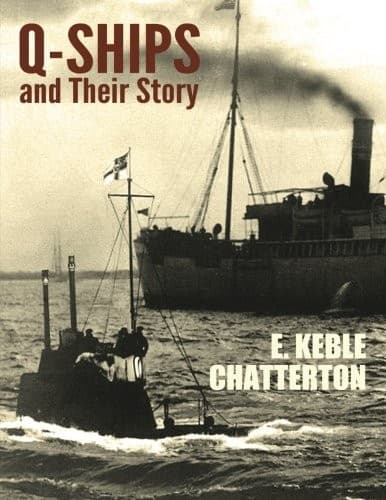
Q-Ships and Their StoryChatterton, E. Keble (Edward Keble)
History
Q-Ships and Their Story
Chatterton, E. Keble (Edward Keble)
Q-ships; World War, 1914-1918 -- Naval operations
The submarine now commenced to dive, and as the stern rose out of the
water the third and fourth shots from the same gun burst on the after
part of the hull in the middle line, the holes made by these three
shots being plainly visible to those in the schooner. The 3-pounder had
also come into action, and out of six rounds the second shot had hit
the hull on the water-line forward of the conning-tower, the third had
hit her on the water-line under the gun, the fourth and fifth bursting
on the after part of the hull just as she was sinking, and the sixth
bursting on the water as her stern disappeared. Badly holed, leaking
from all these holes, UB 39 listed over to port towards the schooner,
vanished from sight for evermore, and then a large quantity of oil and
bubbles came to the surface. There were no survivors.
Having definitely disposed of the enemy, it would be reasonable for
the crew of the _Glen_ to feel elated; but just as UB 39 was finally
disappearing, another submarine was seen approaching about 4,000 yards
off on the starboard bow. _Glen_ opened fire and the enemy submerged,
only to reappear about 600 yards away on the port bow. _Glen_ fired
once more, and next time the submarine appeared a few minutes later on
the port quarter 1,000 yards off. This was happening while the ‘panic
party’ were being got on board again, and thus there was every risk of
being torpedoed; but _Glen_ then proceeded on a northerly course under
sail and motor, and at 7.30 p.m. a very large submarine was observed 2
miles away on the starboard beam, heading in about the same direction.
After ten minutes this submarine opened fire, then turned to pass
astern, and continued firing with both her guns, which _Glen_ answered
with both of hers. About 8 p.m. the duel ceased; the enemy disappeared
to the west on the look-out evidently for a less obstinate ship. If
you examine the positions on the chart you will realize that the enemy
submarines were evidently concentrated in mid-Channel in order to
entrap shipping coming up and down and across the English Channel. They
were so placed as to cut the lines of communication to Cherbourg and at
the same time have a good chance of bagging some liner bound up along.
Public-domain text, read in full here on John Shaqi.
Reviews
Reviews
No reviews yet
Be the first to share your thoughts on this work.
Elsewhere in the archive
Join the Discussion
Join the discussion
Sign in to leave a comment or review.
Sign InorCreate an account