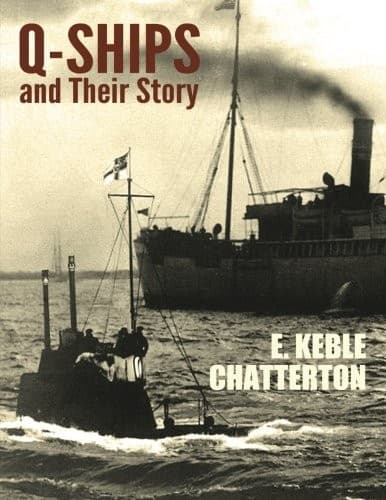
Q-Ships and Their StoryChatterton, E. Keble (Edward Keble)
History
Q-Ships and Their Story
Chatterton, E. Keble (Edward Keble)
Q-ships; World War, 1914-1918 -- Naval operations
This concentration at important centres was noticeable during the
submarine campaign; in fact, but a few weeks later _Glen_ was again
engaged with an enemy in the same vicinity. This was on June 25, the
exact position was 14 miles S. by W. of St. Catherine’s Point, and
the schooner was sailing close hauled on the starboard tack, heading
S.W. by S., doing her 2 knots, when she sighted a vessel apparently
under sail on her port quarter 4 miles distant. Presently this vessel
fired at her, the shot falling 1,000 yards short. This, of course,
was a submarine, and it was a not unusual thing to attempt disguise
by this means; for obviously a low-lying craft on the surface viewed
from a distance would create suspicion. But, parenthetically, it may
be mentioned that this sail device was not always carried out with
common sense, and I remember on one occasion a submarine giving himself
hopelessly away by motoring at good speed in the eye of the wind with
his sail of course shaking wildly. Such an unseamanlike act was at
once spotted by the nearest patrol, and the submarine had to dive so
hurriedly that she left the sail on the water.
In the case of _Glen_ the recognition was obvious as soon as the first
shot was fired. Several minutes later came another, which fell only
60 yards short, so _Glen_ hove-to and ‘abandoned’ ship, the enemy
continuing to fire every few minutes, but the shots fell just over. Her
seventh and eighth shots fell much closer, in fact so near that their
splash flooded the schooner’s deck, and shell splinters struck the
sails and bulwarks. _Glen_ then opened fire with both guns, but this
was a more cautious submarine, who declined to approach nearer than
4,000 yards, fired three more rounds, then submerged and made off.
The activity of the submarines during this week in the neighbourhood
of Portland Bill was most noticeable. Submarines were also stationed
in the western approaches of the English Channel. The reason for this
is not hard to appreciate, for it was on June 26, the day after the
above engagement, that the first contingent of U.S.A. troops landed in
France on the western coast. Whether the transports would be bound up
Channel to Cherbourg or Southampton, the enemy submarines were lying
in wait ready for them. And it is significant that also on June 26 the
Q-sailing-ship _Gaelic_ sighted a submarine at the western entrance of
the English Channel and had a short duel with her.
Public-domain text, read in full here on John Shaqi.
Reviews
Reviews
No reviews yet
Be the first to share your thoughts on this work.
Elsewhere in the archive
Join the Discussion
Join the discussion
Sign in to leave a comment or review.
Sign InorCreate an account