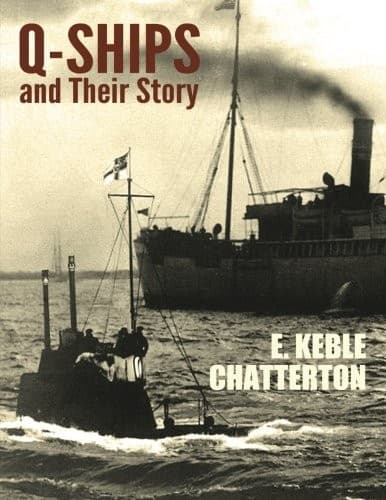
Q-Ships and Their StoryChatterton, E. Keble (Edward Keble)
History
Q-Ships and Their Story
Chatterton, E. Keble (Edward Keble)
Q-ships; World War, 1914-1918 -- Naval operations
Thus, all round our coasts, in the North Sea, English Channel, Irish
Sea, and Atlantic: from as far north as the Orkneys and Shetlands to
as far south as the Bay of Biscay, and as far west as the coast of
North America, these Q-sailing-ships were doing their job of work. The
fitting out, the manning of these craft and of their guns, put a great
strain on our manhood, already greatly diminished by the demands of our
Armies abroad and munition makers at home. Nor could the Navy proper
and the Auxiliary Patrol Force afford to be weakened. On the contrary,
destroyers and light cruisers were being built and commissioned at
a rapid rate: whilst more minesweepers, more trawlers and drifters,
were daily consuming scores of men. Add to this the fact that other
men as gunners were required in great numbers—for practically every
British merchant ship became defensively armed—and one can see how
important to our island nation and the overseas Empire is the existence
of peace-time shipping, with all that it connotes—steamships, liners,
tramps, colliers, trawlers, drifters, yachts, fishing smacks, it does
not matter. From all these, and from the few full-rigged ships and
sailing coasters, we had to draw our supplies of personnel, and it
still takes longer to train a man into a sailor than into a military
unit.
Never before, not even in Armada days, and probably never again, could
such a call come from the fleet in being to the fleet of merchantmen.
The sailing ship has had many centuries of usefulness as a fighting
ship and a cargo carrier, and if she is being gradually killed by the
mechanical ship she is dying hard. Apparently in neither capacity has
she quite finished her fascinating and illustrious history.
CHAPTER XIV
THE SUMMIT OF Q-SHIP SERVICE
It was on February 17, 1917, that Commander Gordon Campbell, still
in command of _Farnborough_, now named Q 5, again sank a submarine,
but in circumstances which, hid from publication at the time, sent a
thrill through the British Navy and especially among those who had the
good fortune to be serving in that area. The scene was again off the
south-west Irish coast, and the enemy at the beginning of the month
had commenced the unrestricted warfare portion of their submarine
campaign. The Germans, as we have since learned, possessed at this
date ninety-five submarines in addition to eight in the Baltic and
thirty-one in the Mediterranean. The orders to their submarine captains
were very drastic and left no uncertainty, and one of these commanding
officers informed one of my friends after the war that unless they were
successful in sinking plenty of shipping they soon were removed from
their command.
[Illustration: THE MASTER OF THE COLLIER “FARNBOROUGH”
Commander Gordon Campbell, V.C., D.S.O., R.N., taken on the bridge of
the “Farnborough” (Q-5), disguised as a master mariner.]
[Illustration: Q-SHIP “FARNBOROUGH”
Public-domain text, read in full here on John Shaqi.
Reviews
Reviews
No reviews yet
Be the first to share your thoughts on this work.
Elsewhere in the archive
Join the Discussion
Join the discussion
Sign in to leave a comment or review.
Sign InorCreate an account