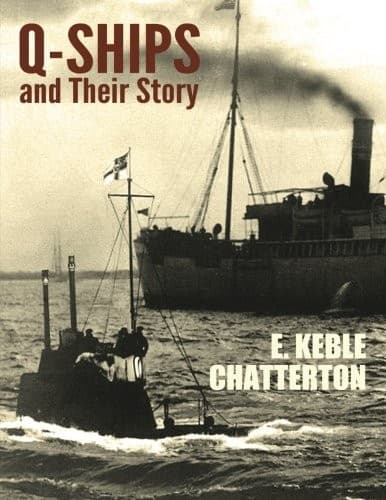
Q-Ships and Their StoryChatterton, E. Keble (Edward Keble)
History
Q-Ships and Their Story
Chatterton, E. Keble (Edward Keble)
Q-ships; World War, 1914-1918 -- Naval operations
The above picture shows her just as she appeared when she destroyed the
U-83. The position of the after gun’s crew can just be seen abaft of
where the sea is breaking over the stern.
To face p. 192]
Every Allied merchant ship was to be attacked without delay. ‘This form
of warfare is to force England to make peace and thereby to decide
the whole war. _Energetic_ action is required, but above all rapidity
of action.’ ‘Our object is to cut England off from traffic by sea,
and not to achieve occasional results at far-distant points. As far
as possible, therefore, stations must be taken up near the English
coast, where routes converge and where divergence becomes impossible.’
If ever there was a chance of attacking by night, this was to be done.
When a ship had been abandoned by her crew the submarine was to sink
her by gunfire, and approach the ship from aft. Owing to the activity
of the British Q-ships, every ship, even sailing vessels, should be
suspected, and both captain and engineer of merchant ships were to be
taken prisoners.
Of the above numbers of submarines available this month not less than
twenty-five and not more than forty-four could actually be at work on
any given date, for the reasons given in another chapter. The first
stages of this unrestricted warfare were most marked, for whereas
the number of merchant ships sunk by submarines in all waters during
December and January had been respectively thirty-six and thirty-five,
in February the total suddenly rose to eighty-six—these sinkings
occurring in the western approaches, especially off the south coast
of Ireland. On February 14 the sailing ship _Eudora_ (1,991 tons) had
been sunk 30 miles S.S.W. of the Fastnet, and three days later the
S.S. _Iolo_ 40 miles S. by W. of the Fastnet, so orders from Germany
were being carried out to the letter. The seventeenth of February was
the Saturday before Ash Wednesday, and Captain Campbell had taken
_Farnborough_ into the locality just mentioned, the exact position
being Lat. 51.34 N., Long. 11.23 W. It was a quarter to ten in the
forenoon and the steamer was steering an easterly course at 7 knots,
when a torpedo was seen approaching. And then occurred a supreme
instance of Q-ship bravery. In his Order Book Captain Campbell had laid
it down that ‘Should the Officer of the Watch see a torpedo coming, he
is to increase or decrease speed as necessary to ensure it hitting.’
This order was read and signed by all his officers, so that there could
be no misunderstanding. The intention was deliberate, premeditated
self-immolation for the greater object of fooling the submarine and
then sinking him. The Q-ship’s company had all been warned that the
intention would be thus, and every man was given an opportunity to
leave the ship before sailing. Not one man left. Therefore to-day, when
a long way off the torpedo was seen approaching, it could easily have
been avoided, but instead, the helm was put hard aport only at the last
Public-domain text, read in full here on John Shaqi.
Reviews
Reviews
No reviews yet
Be the first to share your thoughts on this work.
Elsewhere in the archive
Join the Discussion
Join the discussion
Sign in to leave a comment or review.
Sign InorCreate an account