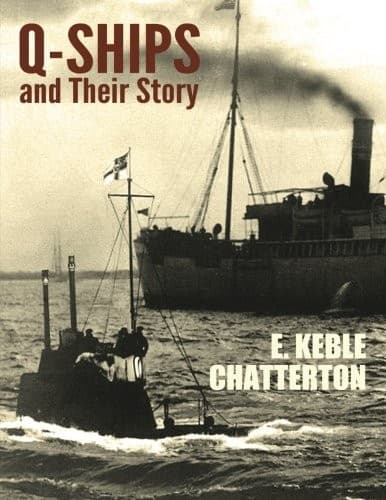
Q-Ships and Their StoryChatterton, E. Keble (Edward Keble)
History
Q-Ships and Their Story
Chatterton, E. Keble (Edward Keble)
Q-ships; World War, 1914-1918 -- Naval operations
minute, and only so that it should strike the ship elsewhere than in
the engine-room. On came the steel fish and struck the ship abreast
of No. 3 hold, wounding an Engineer Sub-Lieutenant, R.N.R., causing a
terrific explosion, and making a huge hole in the ship’s side.
[Illustration: Q-SHIP “FARNBOROUGH”
With White Ensign still flying, after her arrival at Berehaven in a
sinking condition.
To face p. 194]
In the meantime ‘Action’ had been sounded and all hands went to their
stations, the ship being abandoned by every available man with the
exception of those required on board. Thus two lifeboats and one dinghy
full of men were sent to row about, and the fourth boat was partially
lowered. Captain Campbell was lying concealed at one end of the bridge,
watching and waiting in his great isolation. Up through the voice-pipe
came the chief engineer’s report that the engine-room was filling: back
came the captain’s orders that he was to hang on as long as possible
and then hide. This was done. In the meantime _Farnborough’s_ captain
saw the submarine appear on the starboard quarter a couple of hundred
yards away, submerged, but cautiously making a thorough scrutiny of the
ship through his periscope. Then the German—U 83 was her name—came
past the ship on the starboard side only 13 yards away and about 5
yards from the boats. She was so close, in fact, that Captain Campbell,
looking down, could see the whole shape of the submarine below the
water quite distinctly.
Here was the big crisis. Was this the psychological moment? Was this
the right time to make the final gamble? For Captain Campbell the
temptation to open fire was almost unbearable, yet the opportunity was
not yet: he must wait a little longer and live minutes which were like
days. The submarine passed along, then close round _Farnborough’s_
bows, finally breaking surface about 300 yards on the port bow. It was
now five minutes past ten and U 83 motoring along the surface came
past the port side, continuing the scrutiny with less caution born
of satisfaction. The concealed figure on _Farnborough’s_ bridge was
waiting only until all his guns would bear, and as soon as the enemy
thus bore came the great onslaught. It was point-blank range, and the
6-pounder opened the battle, whose first shot hit the conning-tower and
beheaded the German captain.
[Illustration: FIG. 13.—‘FARNBOROUGH’S’ FAREWELL.
When Q 5 (_Farnborough_) had succeeded in sinking U 83, but was
herself in a sinking condition and apparently doomed, Captain
Campbell despatched the above wireless signal to Vice-Admiral Sir
Lewis Bayly, Commander-in-Chief, Queenstown. It was one of the
most pathetic and dramatic messages which ever flashed out of the
Atlantic, but happily Q 5 was salved.]
[Illustration: Q-SHIP “FARNBOROUGH”
Brought safely into Berehaven after her famous fight and beached in
Mill Cove, with a heavy list.]
[Illustration: S.S. “LODORER”
Public-domain text, read in full here on John Shaqi.
Reviews
Reviews
No reviews yet
Be the first to share your thoughts on this work.
Elsewhere in the archive
Join the Discussion
Join the discussion
Sign in to leave a comment or review.
Sign InorCreate an account