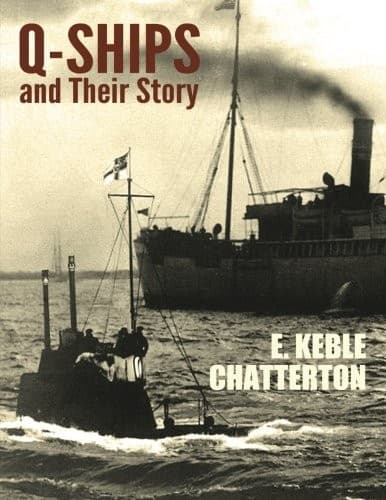
Q-Ships and Their StoryChatterton, E. Keble (Edward Keble)
History
Q-Ships and Their Story
Chatterton, E. Keble (Edward Keble)
Q-ships; World War, 1914-1918 -- Naval operations
At length _Buttercup_ got her in tow, but there is nothing so hard
to steer as a sinking ship, and the tow parted. At 5 p.m. the sloop
again got her in tow, but it was a disappointing business with the
water steadily gaining below and the Atlantic swell breaking over the
after deck, and thus the ships went on through the night. At 2 a.m. on
the Sunday _Farnborough_ suddenly took an alarming list and the water
gained rapidly, so the crew had to be ordered into the boats once
again. The sloop _Laburnum_, which had also arrived, was ordered to
close her an hour and a half later, but just as Captain Campbell was
walking aft off went one of the depth charges with such an explosion
that _Buttercup_, thinking it was a submarine’s torpedo, slipped her
tow. After remaining aboard _Laburnum_ until daylight, Captain Campbell
went back to his ship, and then _Laburnum_ got her in tow. A course
had been set for Bantry Bay, and as she approached she was an amazing
spectacle, listing over to the extent of twenty degrees and her stern
nearly 8 feet under water. However, the armed trawler _Luneda_ and
the tug _Flying Sportsman_ had been sent out to her, and by their
assistance she was brought up the fjord and beached at Mill Cove,
Berehaven, by half-past nine that Sunday night. Next morning, and for
long after, this very ordinary-looking steamer lay among a number of
other wounded ships, a strange and impressive sight. _Farnborough_ had
fought both submarine and adversity, and had won both times: still, had
it not been for sound seamanship and her holds being packed with timber
she would never have been saved.
There was much work to be done and there were too few salvage experts
and men to cope with the results of the submarines’ attacks: so for
the present _Farnborough_ had to remain idle. Months later she was
repaired temporarily, refloated, taken away from Berehaven and properly
reconditioned, but she had ended her days as a warship. She has now
gone back to the Merchant Service as a cargo carrier, and if you ever
go aboard her you will find a suitable inscription commemorating her
truly wonderful career. As for Commander Campbell, as soon as he
had got his ship safely into Berehaven he was summoned to see his
Commander-in-Chief, Admiral Sir Lewis Bayly. After that he was received
by the King, who conferred on him the highest of all awards for heroes.
No details appeared in the Press; only this announcement from the
_London Gazette_:
‘The King has been graciously pleased to approve of the grant of
the Victoria Cross to Commander Gordon Campbell, D.S.O., R.N., in
recognition of his conspicuous gallantry, consummate coolness and skill
in command of one of His Majesty’s ships in action.’
[Illustration: Q-SHIP “PARGUST”
One of Captain Gordon Campbell’s famous commands.]
[Illustration: Q-SHIP “SARAH JONES”
This craft did not come into the service until about three months
before the end of the war. Her alias was “Margaret Murray.”
To face p. 198]
Public-domain text, read in full here on John Shaqi.
Reviews
Reviews
No reviews yet
Be the first to share your thoughts on this work.
Elsewhere in the archive
Join the Discussion
Join the discussion
Sign in to leave a comment or review.
Sign InorCreate an account