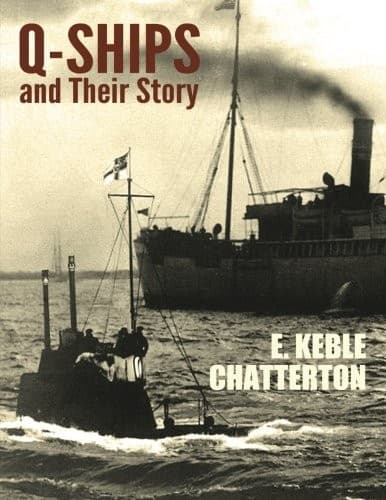
Q-Ships and Their StoryChatterton, E. Keble (Edward Keble)
History
Q-Ships and Their Story
Chatterton, E. Keble (Edward Keble)
Q-ships; World War, 1914-1918 -- Naval operations
Press and public were greatly puzzled, but secrecy was at this time
essential. ‘This,’ commented a well-known London daily, ‘is probably
the first time since the institution of the V.C. that the bestowal of
this coveted honour has been announced without details of the deed for
which it was awarded.’ The popular press named him ‘the Mystery V.C.,’
and the usual crop of rumours and fantastic stories went round. And
while these were being told the gallant commander was busy fitting
out another Q-ship in which to go forth and make his greatest of all
achievements.
This ship was the S.S. _Vittoria_, a collier of 2,817 gross tons. She
was selected whilst lying at Cardiff, whence she was sent to Devonport
to be fitted out as a decoy. Commander Campbell superintended her
alteration, and she began her special service on March 28, 1917. She
was armed with one 4-inch, four 12-pounders, two Maxim guns, and a
couple of 14-inch torpedo tubes. She was a slow creature, 7-1/2 knots
being her speed, but she looked the part she was intended to play. When
Commander Campbell took over the command he was accompanied by his
gallant crew from _Farnborough_. She had been fitted with wireless,
and down in her holds the useful timber had been stowed. On leaving
Devonport she changed her name to _Pargust_, but she was variously
known also as the _Snail_, _Friswell_, and _Pangloss_ at later dates.
She again came under the orders of Sir Lewis Bayly at Queenstown, and
then, being in all respects ready to fight another submarine, _Pargust_
went cruising. She had not long to wait, and on June 7 we find her
out in the Atlantic again, not very far from the scene of her last
encounter. The month of April had been a terrible one for British
shipping; no fewer than 155 of our merchant craft had been sunk by
submarines, representing a loss of over half a million of tonnage.
In May these figures had dropped slightly, but in June they were up
again, though in no month of the war did our losses ever reach the
peak of April again. Nor was it only British ships that so suffered,
and I recollect the U.S.S. _Cushing_ two days previously bringing into
Bantry Bay thirteen survivors, including three wounded, from an Italian
barque. At this time, too, the enemy submarines were laying a number of
dangerous minefields off this part of the world, and as one patrolled
along the south-west Irish coast pieces of wreckage, a meat-safe or a
seaman’s chest, would be seen floating from some victimized steamer.
Public-domain text, read in full here on John Shaqi.
Reviews
Reviews
No reviews yet
Be the first to share your thoughts on this work.
Elsewhere in the archive
Join the Discussion
Join the discussion
Sign in to leave a comment or review.
Sign InorCreate an account