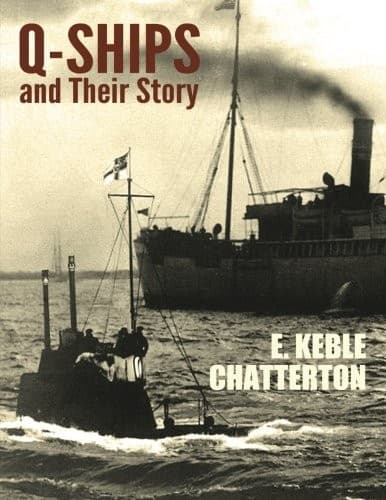
Q-Ships and Their StoryChatterton, E. Keble (Edward Keble)
History
Q-Ships and Their Story
Chatterton, E. Keble (Edward Keble)
Q-ships; World War, 1914-1918 -- Naval operations
The Germans now came on deck, held up their hands, and waved; so
Captain Campbell ordered ‘Cease Fire.’ Then a typically unsportsmanlike
trick was played, for as soon as _Pargust_ stopped firing the enemy
began to make off at a fair speed. So there was nothing for it but to
resume shelling her, and this was kept up until 8.40 a.m., when an
explosion occurred in the forward part of the submarine. She sank for
the last time, falling over on her side, and 3 feet of her sharp bow
end up in the air, 300 yards off, was the last that was ever seen of
her. So perished UC 29, and thus one more submarine was added to the
score of this gallant captain and crew. One officer (a sub-lieutenant
of Reserve) and an engine-room petty officer were picked up. The former
had come on to the submarine’s deck with a couple of men to fire
the 22-pounder, but owing to the heavy sea knocked up by the fresh
southerly wind they had been all washed overboard before reaching the
gun.
[Illustration: BRIDGE OF Q-SHIP “DUNRAVEN”
Captain Gordon Campbell, V.C., D.S.O., R.N., inspecting the damage by
the submarine’s shells to his ship.
To face p. 202]
The captain of UC 29 had been killed by _Pargust’s_ fire. This class
of submarine carried besides her 22-pounder and machine-gun eighteen
mines and three torpedoes. She had left Brunsbüttel on May 25, calling
at Heligoland, and the routine was usually first to lay the mines and
then operate, sinking ships with gun or torpedo. As to her mines, it
is quite possible that she laid the three mines I recollect sinking on
June 12 in the approach to Valentia Harbour, Dingle Bay, and she may
have laid three others off Brow Head, one of which I remember on June
4, for it was customary for these craft to lay their ‘eggs’ in threes.
With regard to her three torpedoes we know that one had penetrated
_Pargust_, another had sunk a sailing ship—probably the Italian barque
already mentioned—and the third had been fired at a destroyer, but
passed underneath.
As to _Pargust_, she fortunately did not sink, thanks to her cargo
of timber. At 12.30 p.m. another of Admiral Bayly’s alert sloops,
who always seemed to be at hand when wanted, arrived. This was
H.M.S. _Crocus_, who took _Pargust_ in tow. The sloop _Zinnia_ and
the United States destroyer _Cushing_ arrived also, and escorted
her to Queenstown, which she reached next afternoon. The prisoners
had been already transferred to _Zinnia_, and in _Pargust_ the only
casualties had been one stoker petty officer killed and the engineer
sub-lieutenant wounded. For _Pargust’s_ splendid victory further
honours were awarded. Captain Campbell, already the possessor of the
V.C. and D.S.O., now received a bar to his D.S.O. To Lieutenant R. N.
Stuart, D.S.O., R.N.R., was given the V.C., and Seaman W. Williams,
R.N.R., also received this highest of all decorations. These two,
one officer and one man, were selected by ballot to receive this
distinction, but every officer and every man had earned it.
Public-domain text, read in full here on John Shaqi.
Reviews
Reviews
No reviews yet
Be the first to share your thoughts on this work.
Elsewhere in the archive
Join the Discussion
Join the discussion
Sign in to leave a comment or review.
Sign InorCreate an account