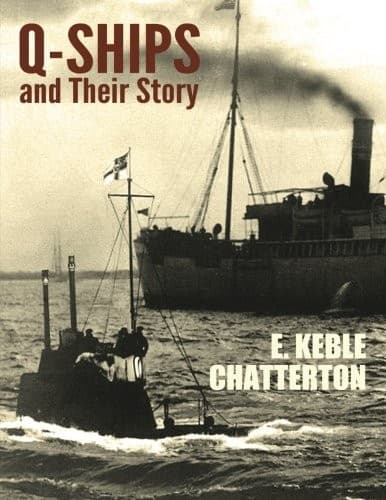
Q-Ships and Their StoryChatterton, E. Keble (Edward Keble)
History
Q-Ships and Their Story
Chatterton, E. Keble (Edward Keble)
Q-ships; World War, 1914-1918 -- Naval operations
As to the officers and men, it is difficult to imagine greater and
more persistent bravery under such adverse circumstances, and the King
made the following awards: Captain Gordon Campbell, V.C., D.S.O.,
received a second bar to his D.S.O.; Lieutenant C. G. Bonner, D.S.C.,
R.N.R., received a V.C., as also did Petty Officer E. Pitcher. To
Assistant-Paymaster R. A. Nunn, D.S.C., R.N.R., was awarded a D.S.O.
Three other officers received a D.S.C., whilst Lieutenant P. R.
Hereford, D.S.O., D.S.C., and two engineer officers, all received a bar
to their D.S.C.
Such is the story of Captain Campbell’s last and greatest Q-ship
fight, for after this he was appointed to command a light cruiser
at Queenstown. In these duels we reach the high-water mark of sea
gallantry, and the incidents themselves are so impressive that no
further words are necessary. Let us leave it at that.
[Illustration: Q-SHIP “DUNRAVEN”
This photograph was taken shortly before she finally sank. Already the
stern is awash.
To face p. 212]
[Footnote 5: Twelve officers and men were selected from a host of
volunteers to try and get the ship in tow. These were placed in a
motor-boat, whilst the Captain boarded the escort to arrange for towage
if possible.]
[Footnote 6: Captain Campbell has been good enough to furnish me with
the following details of this heroic episode:
‘Lieutenant Bonner, having been blown out of his control by the first
explosion, crawled into the gun-hatch with the crew. They there
remained at their posts with a fire raging in the poop below and the
deck getting red-hot. One man tore up his shirt to give pieces to
the gun’s crew to stop the fumes getting into their throats, others
lifted the boxes of cordite off the deck to keep it from exploding, and
all the time they knew that they must be blown up, as the secondary
supply and magazine were immediately below. They told me afterwards
that communication with the bridge was cut off, and although they knew
they would be blown up, they also knew they would spoil the show if
they moved, so they remained until actually blown up with their gun.
Then, when as wounded men they were ordered to remain quiet in various
places during the second action, they had to lie there unattended and
bleeding, with explosions continually going on aboard and splinters
from the shell-fire penetrating their quarters. Lieutenant Bonner,
himself wounded, did what he could for two who were with him in the
wardroom. When I visited them after the action, they thought little of
their wounds, but only expressed their disgust that the enemy had not
been sunk. Surely such bravery is hard to equal. The strain for the men
who remained on board after the ship had been torpedoed, poop set on
fire, cordite and shells exploding, and then the enemy shell-fire, can
easily be imagined.’]
[Footnote 7: See illustration above.]
[Footnote 8: In the meantime he arranged for a further ‘abandon ship’
evolution, having only one gun’s crew on board.]
Public-domain text, read in full here on John Shaqi.
Reviews
Reviews
No reviews yet
Be the first to share your thoughts on this work.
Elsewhere in the archive
Join the Discussion
Join the discussion
Sign in to leave a comment or review.
Sign InorCreate an account