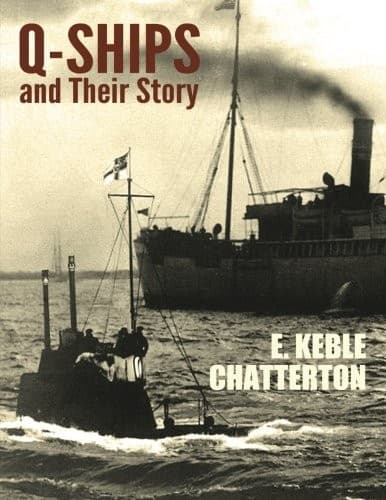
Q-Ships and Their StoryChatterton, E. Keble (Edward Keble)
History
Q-Ships and Their Story
Chatterton, E. Keble (Edward Keble)
Q-ships; World War, 1914-1918 -- Naval operations
_Penshurst_ was a three-masted, single-funnelled, single-screw
steamer, owned by a London firm. She had been fitted out as a decoy at
the end of 1915 by Admiral Colville at Longhope. Her length between
perpendiculars was 225 feet, length over all 232 feet, beam 35 feet
2 inches, draught 14 feet 6 inches, depth of hold 13 feet 7 inches.
Her tonnage was 1,191 gross, 740 registered, displacement 2,035
tons. Fitted with four bulkheads, the ship had the maximum amount of
hold, the engines being placed right aft. The crew were berthed in
the forecastle, the engineers’ mess and cabins being aft, whilst the
captain’s and officers’ mess and cabins were adjacent to the bridge
just forward of midships. The engine-room pressure was 180 pounds, and
the maximum speed, with everything working well and a clean bottom, was
10 knots. Her armament consisted of five guns. A 12-pounder (18 cwt.)
was placed on the after hatch, but disguised in the most ingenious
manner by a ship’s boat, which had been purposely sawn through so that
the detached sections could immediately be removed, allowing the gun
to come into action. Originally there were mounted a 3-pounder and
6-pounder on each side of the lower bridge deck. These were hidden
behind wooden screens such as are often found built round the rails
in this kind of ship. These screens were specially hinged so that on
going into action they immediately fell down and revealed the guns.
Thus it was possible always to offer a broadside of three guns. In
the spring of 1916 _Penshurst_ was transferred from Longhope to Milford
and Queenstown, and Admiral Bayly had the arrangement of guns altered
so that the 3-pounders were now concealed in a gunhouse made out of the
engineers’ mess and cabins, the intention being to enable both these
guns to fire right aft. The 6-pounders were then shifted forward into
the positions previously occupied by the 3-pounders on the lower bridge
deck. How successful this arrangement was in action the reader is able
to see for himself in the accounts of _Penshurst’s_ engagements with
submarines. The ship was also supplied with depth charges, rockets, and
Verey’s lights.
The crew consisted of Captain Grenfell and three temporary R.N.R.
officers, an R.N.R. assistant-paymaster, thirteen Royal Navy gunnery
ratings, eight R.N.R. seamen, a couple of stewards, two cooks, a
shipwright, carpenter’s crew, an R.N.R. chief engine-room artificer, an
engine-room artificer, and R.N.R. stokers, bringing the company up to
forty-five.
Public-domain text, read in full here on John Shaqi.
Reviews
Reviews
No reviews yet
Be the first to share your thoughts on this work.
Elsewhere in the archive
Join the Discussion
Join the discussion
Sign in to leave a comment or review.
Sign InorCreate an account