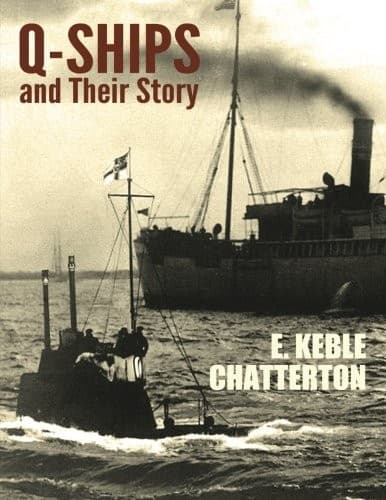
Q-Ships and Their StoryChatterton, E. Keble (Edward Keble)
History
Q-Ships and Their Story
Chatterton, E. Keble (Edward Keble)
Q-ships; World War, 1914-1918 -- Naval operations
In arranging action stations in a Q-ship the difficulty was that
internally the vessel had to be organized as a warship, while
externally she must necessarily keep up the character of a merchantman.
In _Penshurst_ Captain Grenfell had arranged for the following signals
to be rung from the bridge on the alarm gong. One long ring meant that
a submarine was in sight and that the crew were to stand by at their
respective stations; if followed by a short ring it denoted the enemy
was on the starboard side; if two short rings the submarine was on
the port side. Two long rings indicated that the crew were to go to
panic stations; three long rings meant that they were to go to action
stations without ‘panic.’ ‘Open fire’ was ordered by a succession of
short rings and whistles.
With regard to the above, in the case of action stations the look-out
men on the bridge proceeded to their gun at the stand-by signal,
keeping out of sight, while the crews who were below, off watch, went
also to their guns, moving by the opposite side of the ship. In order
to simulate the real mercantile crew, the men under the foc’s’le now
came out and showed themselves on the fore well deck. If ‘panic’ was to
be feigned, all the crew of the gun concealed by the collapsible boat
were to hide, the signalman stood by to hoist the White Ensign at the
signal to open fire, and the boat party ran aft, turned out the boats,
lowered them, and ‘abandoned’ ship, pulling away on the opposite bow.
The signal for standing-by to release the depth charge was when the
captain dropped a red flag, and all guns’ crews were to look out to
fire on the enemy if the depth charge brought the U-boat to the surface.
[Illustration:
[_Photo. Heath and Stoneman_
THE GALLANT OFFICERS AND CREW OF THE Q-SHIP “DUNRAVEN.”
Captain Gordon Campbell is in the second row with Lieutenant C. G.
Bonner on his right.
To face p. 216]
Public-domain text, read in full here on John Shaqi.
Reviews
Reviews
No reviews yet
Be the first to share your thoughts on this work.
Elsewhere in the archive
Join the Discussion
Join the discussion
Sign in to leave a comment or review.
Sign InorCreate an account