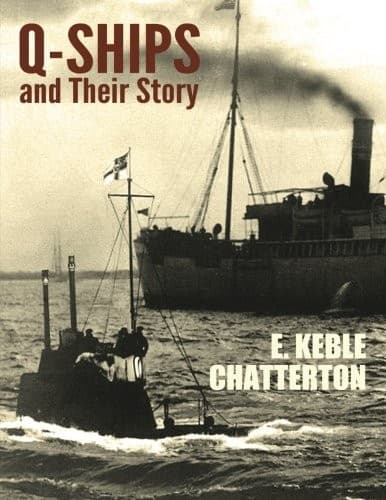
Q-Ships and Their StoryChatterton, E. Keble (Edward Keble)
History
Q-Ships and Their Story
Chatterton, E. Keble (Edward Keble)
Q-ships; World War, 1914-1918 -- Naval operations
But the Q-ship service was not a short series of three or four spasms,
but took its part in the persistent prosecution of the anti-submarine
campaign. It remained a perpetual thorn in the enemy’s side, and it
was a most dangerous thorn. Unlike the U-boat service in its later
stages, it continued to be composed of volunteers, and it was certainly
the means of bringing to light extraordinary talent and courage.
Like other children, the seaman loves dressing up and acting. In the
Q-ship he found this among the other attractions, of which not the
least was the conscious joy of taking a big share in the greatest of
all wars. In one Q-ship alone were earned no fewer than four D.S.O.’s
and three bars, five D.S.C.’s and seven bars, one Croix de Guerre,
and six ‘mentions’ among the officers. Among the men this ship earned
twenty-one D.S.M.’s and four bars, as well as three ‘mentions.’ To-day
as you pass some tired old tramp at sea, or watch a begrimed steamer
taking in a cargo of coals, you may be gazing at a ship as famous as
Grenville’s _Revenge_ or Drake’s _Golden Hind_. At the end of the war
the Admiralty decided to place a memorial tablet on board each merchant
vessel that had acted as a decoy during the war, the tablet being
suitably inscribed with details of the gallant ship’s service, together
with the names of the commanding officer and members of the crew who
received decorations. The first of these ships so to be commemorated
was the _Lodorer_, better known to us as Captain Campbell’s Q-ship
_Farnborough_. After hostilities, in the presence of representatives
of the owners and the Ministry of Shipping, Vice-Admiral Sir Alexander
Duff unveiled _Lodorer’s_ tablet, and those who read it may well think
and reflect.
CHAPTER XVI
Q-SHIPS EVERYWHERE
In the spring of 1917 there was a 2,905-ton steamship, called the
_Bracondale_, in the employment of the Admiralty as a collier. It
was decided that she would make a very useful Q-ship, so at the
beginning of April she was thus commissioned and her name changed to
_Chagford_. She was fitted out at Devonport and armed with a 4-inch,
two 12-pounders, and a couple of torpedo tubes, and was ready for sea
at the end of June. Commanded by Lieutenant D. G. Jeffrey, R.N.R., she
proceeded to Falmouth in order to tune everything up, and then was
based on Buncrana, which she left on August 2 for what was to be her
last cruise, and I think that in the following story we have another
instance of heroism and pertinacity of great distinction.
Public-domain text, read in full here on John Shaqi.
Reviews
Reviews
No reviews yet
Be the first to share your thoughts on this work.
Elsewhere in the archive
Join the Discussion
Join the discussion
Sign in to leave a comment or review.
Sign InorCreate an account