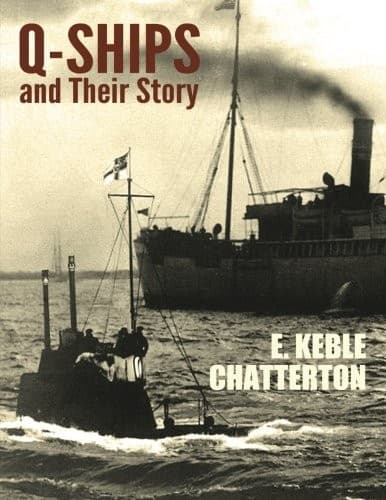
Q-Ships and Their StoryChatterton, E. Keble (Edward Keble)
History
Q-Ships and Their Story
Chatterton, E. Keble (Edward Keble)
Q-ships; World War, 1914-1918 -- Naval operations
of leaf’ at home, so as to tell his family all about it. Never again
would he overstay his leave: back to the ship for him to give further
evidence of his prowess.
This was the kind of fellow who could be relied upon to maintain at
sea the gallant traditions of British seamanhood, and in their time
of greatest peril the true big-souled character manifested itself, as
real human truth always emerges in periods of crisis. I am thinking
of one man who served loyally and faithfully in a certain Q-ship. In
one engagement this gallant British sailor while in the execution of
his duty was blown literally to pieces except for an arm, a leg in a
sea-boot, and the rest a mere shattered, indescribable mass, his blood
and flesh being scattered everywhere by the enemy’s attack. And yet the
last words of this good fellow, spoken just before it was too late, did
much to help the Q-ship in her success. In a previous engagement this
man’s gun had the misfortune to start with seven missfires. This was
owing to ammunition rendered faulty by having been kept on the deck
too long as ‘ready-use.’ Consequently his gun did not come into action
as quickly as the others. This piece of bad luck greatly upset such a
keen warrior, and he was determined that no such accident should occur
again. Therefore, in the next fight, just as he was crouching with
his gun’s crew behind the bridge-screen, he was heard to say to his
mates: ‘Now, mind. We’re to be the _first_ gun in action this time.’
Immediately afterwards a shell came and killed him instantaneously.
Or, again, consider the little human touch in the case of the Q-ship
commanded by Lieut.-Commander McLeod, which had been ‘done in’ and was
sinking, so that she had really to be abandoned. When all were getting
away in the boats, Lieut.-Commander McLeod’s servant was found to be
missing. At the last moment he suddenly reappeared, carrying with him
a bag which he had gone back to fetch. In it was Lieut.-Commander
McLeod’s best monkey-jacket. ‘I thought as you might want this, sir,
seeing you’ll have to go and see the Admiral when we get back to
Queenstown,’ was his cool explanation. Nothing could crush this kind of
spirit, which prevailed in the trenches, the air, and on sea until the
Armistice was won. It is the spirit of our forefathers, the inheritance
of our island race, which, notwithstanding political and domestic
tribulations, lies silent, dormant, undemonstrative, until the great
hour comes for the best that is in us to show itself. Germany, of
course, had her disguised armed ships, such as the _Moewe_, the _Wolf_,
and so on, and with them our late enemies performed unquestionably
brilliant work all over the world. It is true, also, that a similar
achievement was attained in one disguised sailing ship; nor can we fail
to admire the pluck and enterprise which enabled them to get through
the British blockade. To belittle such first-class work would be to
turn one’s back on plain truth.
Public-domain text, read in full here on John Shaqi.
Reviews
Reviews
No reviews yet
Be the first to share your thoughts on this work.
Elsewhere in the archive
Join the Discussion
Join the discussion
Sign in to leave a comment or review.
Sign InorCreate an account