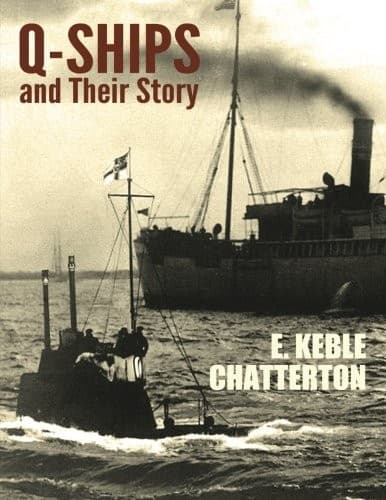
Q-Ships and Their StoryChatterton, E. Keble (Edward Keble)
History
Q-Ships and Their Story
Chatterton, E. Keble (Edward Keble)
Q-ships; World War, 1914-1918 -- Naval operations
Here was another doomed ship rolling about in the Atlantic without her
crew, and only a gallant handful of British seamanhood still standing
by with but a shred of hope. To accentuate their suspense periscopes
were several times seen, and from 9 a.m. until 9 p.m. a submarine
frequently appeared on the surface at long range, and almost every
hour a periscope passed round the ship inspecting her cautiously.
During the whole of this time _Chagford_ was settling down gradually
but certainly. At dark Lieutenant Jeffrey, fearing that the enemy
might attempt boarding, placed Lewis and Maxim guns in position and
served out rifles and bayonets to all. Midnight came, and after making
a further examination of the damage, Lieutenant Jeffrey realized that
it was impossible for the _Chagford_ to last much longer, for her main
deck amidships was split from side to side, the bridge deck was badly
buckled, and the whole ship was straining badly. Therefore, just before
half-past midnight, these five abandoned the ship in a small motor-boat
which they had picked up at sea some days previously, but before
quitting _Chagford_ they disabled the guns, all telescopic sights and
strikers being removed.
Having shoved off, they found to their dismay that there were no tanks
in the motor-boat, so she had to be propelled by a couple of oars, and
it will readily be appreciated that this kind of propulsion in the
North Atlantic was not a success. They then thought of going back to
the ship, but before they could do so they were fortunately picked up
at 7.30 a.m. by H.M. trawler _Saxon_, a large submarine having been
seen several times on the horizon between 4 and 7 a.m. The trawler then
proceeded to hunt for the submarine, but, as the latter had now made
off, volunteers were called for and went aboard _Chagford_, so that
by 4 p.m. _Saxon_ had commenced towing her. Bad luck again overcame
their efforts, for wind and sea had been steadily increasing, and of
course there was no steam, so the heavy work of handling cables had all
to be done by hand. Until the evening the ship towed fairly well at 2
knots, but, as she seemed then to be breaking up, the tow-rope had to
be slipped, and just before eight o’clock next morning (August 7) she
took a final plunge and disappeared. The _Saxon_ made for the Scottish
coast and landed the survivors at Oban on the morning of the eighth. In
this encounter, difficult as it was, _Chagford_ had done real service,
for she had damaged the submarine so much that she could not submerge,
and this was probably U 44 which H.M.S. _Oracle_ sighted in the early
hours of August 12 off the north coast of Scotland, evidently bound
to Germany. _Oracle_ chased her; U 44 kept diving and coming to the
surface after a short while. She had disguised herself as a trawler,
and was obviously unable to dive except for short periods. _Oracle_
shelled and then rammed her, so that U 44 was destroyed and _Chagford_
avenged.
Public-domain text, read in full here on John Shaqi.
Reviews
Reviews
No reviews yet
Be the first to share your thoughts on this work.
Elsewhere in the archive
Join the Discussion
Join the discussion
Sign in to leave a comment or review.
Sign InorCreate an account