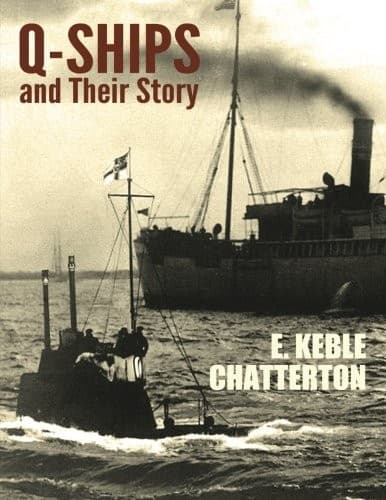
Q-Ships and Their StoryChatterton, E. Keble (Edward Keble)
History
Q-Ships and Their Story
Chatterton, E. Keble (Edward Keble)
Q-ships; World War, 1914-1918 -- Naval operations
Nothing more was seen of _Chagford_ except some wreckage found
by a trawler on August 11, who noticed the word _Bracondale_ on the
awnings.
After Lieutenant Jeffrey and crew had returned to their base they
proceeded to fit out the 2,794-ton S.S. _Arvonian_. This was to be a
very powerful Q-ship, for she was armed with three 4-inch guns instead
of one, in addition to three 12-pounders, two Maxim guns, and actually
four 18-inch torpedo tubes. She was, in fact, a light cruiser, except
for speed and appearance, but the _Chagford_ crew were destined to
disappointment, for this is what happened. The reader will recollect
that in her engagement of June 7, 1917, Captain Campbell’s famous ship
_Pargust_ received so much damage that she had to be left in dockyard
hands while he and his crew went to sea in the _Dunraven_. Now, at
the beginning of October Admiral Sims asked the British Admiralty for
a ship to carry out this decoy work, and to be manned by the United
States Navy. The Admiralty therefore selected _Pargust_, and Admiral
Sims then assigned her to the U.S.N. forces based on Queenstown. Her
repairs, however, took rather a longer time than had been hoped; in
fact, she was not finished and commissioned again until the following
May, so it was decided to pay off _Arvonian_ on November 26, 1917,
and she was then recommissioned with a United States crew under
Commander D. C. Hanrahan, U.S.N., and changed her name to _Santee_.
By the time she left Queenstown for her maiden cruise she was a very
wonderful ship. Her 4-inch guns had been disguised by being recessed,
and by such concealments as lifebuoy lockers, hatch covers, and so on.
The 12-pounder gun aft had a tilting mounting, as also had the two
12-pounders forward at the break of the fo’c’sle on either side. Thus
they were concealed, but could be instantly brought into position.
Her four torpedo tubes were arranged so that there was one on each
beam, one to fire right ahead, and one to fire right astern. She also
boasted of a searchlight, a wireless set, and an emergency wireless
apparatus. She had two lifeboats, two skiffs, two Carley floats, and
also a motor-boat. She was thus the last word in Q-ship improvements,
and embodied all the lessons which had been learnt by bitter and tragic
experience. Two days after Christmas, 1917, she left Queenstown at dusk
on her way to Bantry Bay to train her crew, but in less than five hours
she was torpedoed. It was no disgrace, but a sheer bit of hard luck
which might have happened to any other officer, British or American.
Commander Hanrahan was one of the ablest and keenest destroyer captains
of the American Navy, and no one who had ever been aboard his ship
could fail to note his efficiency. He had been one of the early
destroyer arrivals when the United States that summer had begun to send
their destroyer divisions across the Atlantic to Queenstown, and he had
done most excellent work.
Public-domain text, read in full here on John Shaqi.
Reviews
Reviews
No reviews yet
Be the first to share your thoughts on this work.
Elsewhere in the archive
Join the Discussion
Join the discussion
Sign in to leave a comment or review.
Sign InorCreate an account