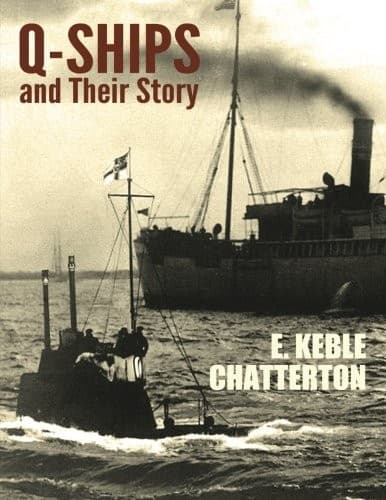
Q-Ships and Their StoryChatterton, E. Keble (Edward Keble)
History
Q-Ships and Their Story
Chatterton, E. Keble (Edward Keble)
Q-ships; World War, 1914-1918 -- Naval operations
Q-ships were kept pretty busy, too, in the Mediterranean. On March
11, 1917, when _Wonganella_ (Lieut.-Commander B. J. D. Guy, R.N.) was
on her way from Malta to England via Gibraltar, she was shelled by a
submarine, and while the ‘panic’ party were getting out the boats, a
shell wounded the officer and several of the crew in the starboard
lifeboat. Another shell went through the bulwarks of the ship, wounding
some men and bursting the steam-pipe of the winch, thus rendering
unworkable the derrick used for hoisting out the third boat, and the
port lifeboat was also damaged. Shells burst in the well deck and
holed the big boat, so in this case, as all his boats were ‘done in,’
the captain had to give up the idea of ‘abandoning’ ship. There was
nothing for it but to open fire, though it was not easy for orders to
be heard in that indescribable din when shells were bursting, steam
pouring out from the burst winch-pipe, wounded men in great pain, and
_Wonganella’s_ own boiler-steam blowing off with its annoying roar. As
soon as fire was opened, the submarine dived and then fired a torpedo,
which was avoided by _Wonganella_ going astern with her engines, the
torpedo just missing the ship’s fore-foot by 10 feet. No more was seen
of the enemy, and at dusk the armed steam yacht _Iolanda_ was met, from
whom a doctor was obtained, thus saving the lives of several of the
wounded. In this engagement, whilst the White Ensign was being hoisted,
the signal halyards were shot away, so the ensign had to be carried up
the rigging and secured thereto.
_Wonganella_ was holed on the water-line and hit elsewhere, but she
put into Gibraltar on March 13, and on the evening of June 19 of the
same year we find her out in the Atlantic west of the south-west
Irish coast on her way homeward-bound from Halifax. A submarine bore
down on her from the north, and at the long range of 8,000 yards was
soon straddling _Wonganella_. Now the Q-ship happened to have on
board thirty survivors from a steamer recently sunk, so again it was
impossible to attempt the ‘abandon ship’ deception. She therefore
used her smoke-screen—at this time ships were being supplied with
special smoke-making apparatus—and then ran down the wind at varying
speeds and on various courses, with the hope that the enemy would
chase quickly. _Wonganella_ would then turn in the smoke-cloud and
suddenly emerge and close the enemy at a more suitable range. But the
best-laid schemes of Q-ships are subject to the laws of chance, for
now there appeared another merchant ship heading straight towards this
scene, and thus unwittingly frustrated the further development of the
encounter. This ‘merchant ship’ was the Q-ship _Aubrietia_ (Q 13), who
did, in fact, receive a signal from _Wonganella_ that no assistance was
required; but by that time it was too late to withdraw. The submarine,
after shelling _Wonganella_ through the smoke, abandoned the attack and
withdrew without ever scoring a hit.
Public-domain text, read in full here on John Shaqi.
Reviews
Reviews
No reviews yet
Be the first to share your thoughts on this work.
Elsewhere in the archive
Join the Discussion
Join the discussion
Sign in to leave a comment or review.
Sign InorCreate an account