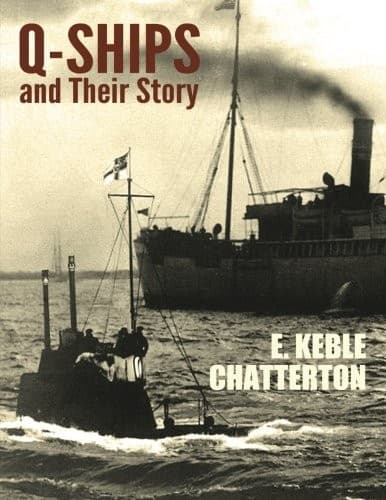
Q-Ships and Their StoryChatterton, E. Keble (Edward Keble)
History
Q-Ships and Their Story
Chatterton, E. Keble (Edward Keble)
Q-ships; World War, 1914-1918 -- Naval operations
Under the new scheme just mentioned these four Q-ships were so
worked that they always arrived and sailed from Gibraltar as part
of the convoy of merchant ships, from which class they could not be
distinguished. But already long before this date Q-ships had been
employed in such distant waters. For instance, in the middle of
November, 1916, the _Barranca_ (Lieut.-Commander S. C. Douglas, R.N.)
was sent from Queenstown via Devonport, and proceeded to operate in the
neighbourhood of Madeira and the Canaries, based on Gibraltar. This
ship, known officially as Q 3 (alias _Echunga_), had been taken over
from Messrs. Elders and Fyffes, Ltd. Her registered tonnage was 4,115,
and she had a speed of 14 knots, so she was eminently fitted for this
kind of work. She had been employed as a Q-ship since June, 1916, and
was armed with a 4-inch, two 12-pounders, and two 6-pounders, and
terminated her service in the following May. Her captain had been one
of the earliest officers to be employed in decoy work, having been
second in command to Lieut.-Commander Godfrey Herbert when that officer
commanded the _Antwerp_. Soon after this date the Q-ship _Dunclutha_
left for that part of the Atlantic which is between the north-east
coast of South America and north-west coast of Africa. This ship,
together with _Ooma_, both of them being vessels of between 3,000 and
4,000 tons, had commenced their special service at the end of 1916
and been sent to work under the British Commodore off the east coast
of South America in the hope of falling in with one of the German
raiders, such as the _Moewe_. In May, 1918, both these vessels had to
be withdrawn from such service, as the shortage of tonnage had become
acute, and were required to load general cargo in a Brazilian port.
Another of these overseas Q-ships was the _Bombala_ (alias _Willow
Branch_). She was a 3,314-ton steamer and had left Gibraltar on April
18, 1918, for Sierra Leone. A week later, off the West African coast,
she sighted a submarine off the port quarter, and a few minutes later a
second one off the starboard bow. Both submarines opened their attack
with shells, this class of submarine being armed with a couple of
5·9-inch guns. After about thirty rounds the enemy had found the range,
and then began to hit the ship repeatedly, carrying away the wireless
and causing many casualties. _Bombala_ shortened the range so that
she could use her 4-inch and 14-pounder, and the action went on for
two and a half hours. By that time _Bombala_ was done for, and it was
impossible to save the ship; so the crew were ordered into the boats,
and then the ship foundered, bows first. However, the Q-ship had not
sunk without severely damaging the enemy, for when the submarines came
alongside _Bombala’s_ boats it was found that in one of the submarines
there were seven killed and four wounded.
Public-domain text, read in full here on John Shaqi.
Reviews
Reviews
No reviews yet
Be the first to share your thoughts on this work.
Elsewhere in the archive
Join the Discussion
Join the discussion
Sign in to leave a comment or review.
Sign InorCreate an account