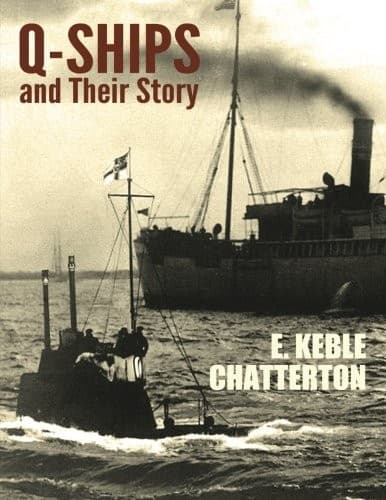
Q-Ships and Their StoryChatterton, E. Keble (Edward Keble)
History
Q-Ships and Their Story
Chatterton, E. Keble (Edward Keble)
Q-ships; World War, 1914-1918 -- Naval operations
These trawlers were undoubtedly both a valuable protection to the
fishermen (who had been repeatedly attacked by the enemy) and a subtle
trap for some of the less experienced submarine captains. During May
two more trawlers, the _Strathallan_ and _Strathearn_, were similarly
commissioned, and even steam drifters such as the _Fort George_
(armed with one 6-pounder) were employed in this kind of work. On the
thirteenth of June _Strathearn_ was fishing 19 miles east of the Bell
Rock when five shots were fired at her, presumably by a submarine,
though owing to the hazy weather nothing could be seen. The enemy then
evidently sighted a destroyer and disappeared. On the following day
_Fort George_ was fishing about 35 miles east of May Island, when she
was attacked by submarine at 2,000 yards. It was ten o’clock at night,
and the drifter, after the third round, secured her fishing gear and
returned the fire. The enemy was evidently surprised, for after the
drifter had fired three shells the German broke off the engagement
and submerged, but with his fourth and fifth rounds he had hit _Fort
George_, killing two and wounding another couple.
But on the following twenty-eighth of January _Fort George_ was about
14 miles east of May Island, with the decoy trawler _W. S. Bailey_
(Lieutenant C. H. Hudson, D.S.C., R.N.R.). The two ships were listening
on their hydrophones when a submarine was distinctly heard some
distance away, and it was assumed that the enemy was steering for May
Island, so the _W. S. Bailey_ after proceeding for a quarter of an
hour in that direction listened again, and the sounds were heard more
plainly. For an hour and a half the enemy was determinedly hunted,
and just after 9 p.m. the sounds became very distinct, so the trawler
steamed full speed ahead in the submarine’s direction, dropped a depth
charge, listened, and then, as the enemy was still heard on the
hydrophone, a second charge was dropped. The trawler then went full
speed astern to check her way, and just as she was stopping there were
sighted two periscopes not 20 yards away, on the starboard quarter, and
going full speed. The trawler then dropped a third depth charge over
the spot where the periscopes had disappeared, and nothing further was
heard on the hydrophone, but a fourth charge was then let go to make
sure, and the position was buoyed, and the disguised craft remained
in the vicinity until January 30. A few days later the _W. S. Bailey_
swept with her chain-sweep over the position, and on each occasion the
sweep brought up in the place that had been buoyed, and a quantity of
oil was seen. Local fishermen accustomed to working their gear along
this bottom reported that the obstruction was quite new. In short, the
_W. S. Bailey_ had succeeded in destroying UB 63, a submarine about 180
feet long and well armed with a 4·1-inch gun and torpedoes. For this
useful service Lieutenant Hudson received a bar to his D.S.C., while
Skipper J. H.
Public-domain text, read in full here on John Shaqi.
Reviews
Reviews
No reviews yet
Be the first to share your thoughts on this work.
Elsewhere in the archive
Join the Discussion
Join the discussion
Sign in to leave a comment or review.
Sign InorCreate an account