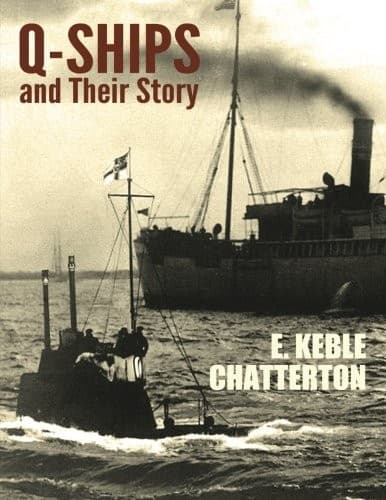
Q-Ships and Their StoryChatterton, E. Keble (Edward Keble)
History
Q-Ships and Their Story
Chatterton, E. Keble (Edward Keble)
Q-ships; World War, 1914-1918 -- Naval operations
Lawrence, R.N.R., was awarded the D.S.C.
Thus, in all waters and in all manner of ships wearing every kind of
disguise, the shy submarine was being tempted and sought out, though
every month decoy work was becoming more and more difficult: for though
you might fool the whole German submarine service in the early stages
of Q-ships, it was impossible that you could keep on bluffing all of
them every time. The most that could be expected was that as a reward
for your constant vigilance and perfect organization you might one day
catch him off his guard through his foolishness or lack of experience
or incautiousness. But every indecisive action made it worse for the
Q-ships, for that vessel was a mark for future attack and the enemy’s
intelligence department was thereby enriched, and outgoing submarines
could be warned against such a trawler or such a tramp whose guns had a
dead sector on such a bearing. Thus an inefficient Q-ship captain would
be a danger not merely to himself and his men, but to the rest of the
force. Nothing succeeds like success, and there was nothing so useful
as to make a clean job of the submarine-sinking, so that he could never
get back home and tell the news. Surprise, whether in real life or
fiction, is a factor that begins to lose its power in proportion to its
frequency of use. It was so in the Q-ships, and that is why, after a
certain point had been reached, this novel method became so difficult
and so barren in results.
CHAPTER XVII
SHIPS OF ALL SIZES
The unrestricted phase of submarine warfare instituted in February,
1917, had, apart from other means, been met by an increase in the
number of Q-ships, so that by the end of May there were close upon
eighty steamers and sailing craft either being fitted out as decoys or
already thus employed. By far the greater number of the big Q-ships
were serving under Admiral Bayly, the other large craft being based
on Longhope, Portsmouth, the south-east of England, and Malta. Of
the smaller types, such as trawlers and sailing ships, no fewer than
one-half were based on Granton, under Admiral Startin, the rest of
these little vessels working out of Stornoway, Longhope, Peterhead,
Lowestoft, Portsmouth, Plymouth, Falmouth, Milford Haven, and Malta.
Public-domain text, read in full here on John Shaqi.
Reviews
Reviews
No reviews yet
Be the first to share your thoughts on this work.
Elsewhere in the archive
Join the Discussion
Join the discussion
Sign in to leave a comment or review.
Sign InorCreate an account