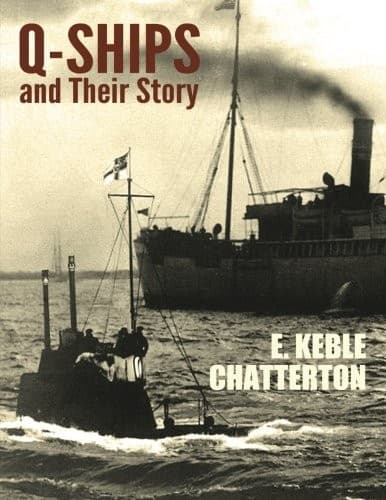
Q-Ships and Their StoryChatterton, E. Keble (Edward Keble)
History
Q-Ships and Their Story
Chatterton, E. Keble (Edward Keble)
Q-ships; World War, 1914-1918 -- Naval operations
This was about as much as the stunned submarine could stand, and
forging ahead she suddenly submerged and sank stern first, but a few
seconds later she rose to the surface with a heavy list to starboard,
and then sank for good and all. For, on submerging, she had found
she was leaking so badly that her condition was hopeless, and she
was doubtless intending to surrender, but apparently the fourth shot
from _Stonecrop_ had so damaged the conning-tower hatch that it could
not be opened. Thus there perished U 88, but this was more than the
sinking of an ordinary submarine, for with her there went to his doom
Lieut.-Commander Schwieger, who, when in command of U 20, had sunk
the _Lusitania_ on May 7, 1915, with the loss of over eleven hundred
men, women, and children. Altogether _Stonecrop’s_ action had been very
neat. He had lured the enemy into a short range, utterly fooled him,
and then disabled him before he woke up. For this service Commander
Blackwood received the D.S.O., and three R.N.R. lieutenants and a naval
warrant officer each received a D.S.C. But Q-ship life was always full
of uncertainties, for on the very next day _Stonecrop_ was herself
torpedoed by another submarine at 1 p.m., though fortunately this
was in a position a little nearer the coast. Two officers and twenty
survivors were picked up by a motor-launch of the Auxiliary Patrol
and landed at Berehaven; sixty-four men in one boat and a raft were
remaining behind, but all available craft were sent out to rescue them.
The employment of small coasting steamers was, during the last phase
of the war, more and more developed. What the Q-ship captain liked was
that the enemy should attack him not with torpedoes but with gunfire.
Now, even the biggest German submarines carried usually not more than
ten torpedoes, and inasmuch as his cruise away from any base lasted
weeks, and, in the case of the _Deutschland_ class, even months, it
was obvious that the U-boat had to conserve his torpedoes for those
occasions which were really worth while. From this it follows that
a submarine captain who knew his work, and was anxious to make a
fine haul before ending his cruise, would not, as a rule, waste his
torpedoes on a 500-ton steamer when he might have secured much bigger
tonnage by using the same missile against a 20,000-ton liner.
Public-domain text, read in full here on John Shaqi.
Reviews
Reviews
No reviews yet
Be the first to share your thoughts on this work.
Elsewhere in the archive
Join the Discussion
Join the discussion
Sign in to leave a comment or review.
Sign InorCreate an account