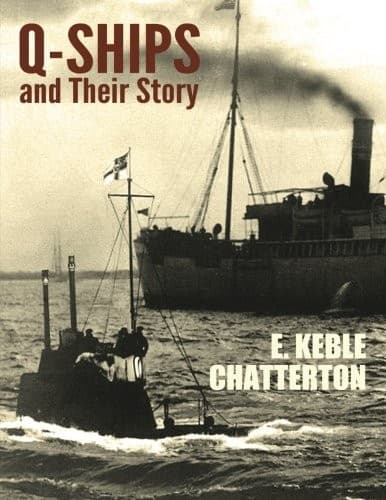
Q-Ships and Their StoryChatterton, E. Keble (Edward Keble)
History
Q-Ships and Their Story
Chatterton, E. Keble (Edward Keble)
Q-ships; World War, 1914-1918 -- Naval operations
This suggested an avenue of thought, and as early as January, 1918,
the matter was considered by Admiral Bayly and developed. Already
there were in existence several small vessels acting as Q-ships,
but simultaneously carrying out in all respects the duties of
cargo-carriers from port to port, and thus paying their way. It was
now decided to look for a little steamer which, based on Queenstown,
would work between the Bristol Channel, Irish Sea, and the south coast
of Ireland, where even during the height of the submarine campaign it
was customary to see such craft. As a result of this decision Captain
Gordon Campbell was sent to inspect the S.S. _Wexford Coast_, which
was being repaired at Liverpool. Her gross tonnage was only 423,
she had a well deck, three masts, and engines placed aft: just the
ordinary-looking, innocent steamer that would hardly attract a torpedo.
Owned by Messrs. Powell, Bacon, Hough, and Co., of Liverpool, this
vessel had already done valuable work in the war; for in 1915 she had
been requisitioned for store-carrying in the Dardanelles, where she was
found invaluable in keeping the troops supplied, and when that campaign
came to an end assisted at the evacuation. Returning to England, she
was again sent out as a store-carrier, this time to the White Sea.
_Wexford Coast_ was now taken up as a Q-ship, her fitting-out being
supervised by Lieut.-Commander L. S. Boggs, R.N.R., who had been in
command of the Q-ship _Tamarisk_, and from the last ship came a large
part of her new crew. She was duly armed, and fitted with a cleverly
concealed wireless aerial, to be used only in case of emergency, and
was then commissioned on March 13, 1918, as ‘Store-Carrier No. 80,’
this title being for the purpose of preserving secrecy. She put to sea
in her dual capacity, but on August 31 had the misfortune to be run
into by the French S.S. _Bidart_, six miles south-east of the Start, at
four o’clock in the morning—another instance of this fatal hour for
collisions. The Frenchman grounded on the Skerries and capsized, and
the _Wexford Coast_ had to put in to Devonport. After the sinking of
the Q-ship _Stockforce_ (to be related presently), Admiral Bayly wished
the captain and crew of the latter to be appointed to a coaster similar
to _Wexford Coast_, so the _Suffolk Coast_ was chosen at the beginning
of August whilst she was lying in the Firth of Forth. Before the end
of the month she had arrived at Queenstown, where she was fitted out.
On November 10 she set out from Queenstown, but on the following day
came the Armistice, which spoiled her ambitions. However, in this, the
latest of all Q-ships, we see the development so clearly that it will
not be out of place here to anticipate dates and give her description.
Public-domain text, read in full here on John Shaqi.
Reviews
Reviews
No reviews yet
Be the first to share your thoughts on this work.
Elsewhere in the archive
Join the Discussion
Join the discussion
Sign in to leave a comment or review.
Sign InorCreate an account