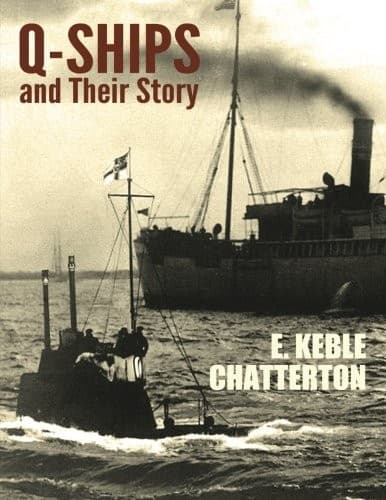
Q-Ships and Their StoryChatterton, E. Keble (Edward Keble)
History
Q-Ships and Their Story
Chatterton, E. Keble (Edward Keble)
Q-ships; World War, 1914-1918 -- Naval operations
Every new aspect of the submarine advancement had to be thought out
and met, and the variations were most noticeable, but during the last
few months of the war considerable attention had to be concentrated on
the areas of the Azores, the north, south, east, and west of Ireland,
the Bristol Channel, and the approaches to the English Channel in the
west. But by the spring of 1918 the crews of German submarines had
become distinctly inferior. Their commanding officers were often young
and raw, there was a great dearth of trained engineer officers and
experienced petty officers, and this was shown in frequent engine-room
breakdowns. So many submarines had failed to return home, and others
reported such hairbreadth escapes, that the inferior crews became
nervous and were not sorry to be taken prisoners. The fact was that
not only were expert, highly skilled officers hard to find, but the
hands he was compelled to go to sea with were no longer chosen by the
captain; he had to accept whatever recruits were drafted to his craft.
Of the best _personnel_ that remained many had lost their nerve and
had a very real dread of mines, depth charges, and decoy ships. The
institution of our convoy system and of Q-ships as part of the convoy
did not add to the pleasures of the U-boat officers. It is true that
the often excellent shooting of the submarines was due to the fact
that their gun-layers were generally selected from the High Sea Fleet,
but as against this many of our Q-ship expert gunners were out of the
Grand Fleet. It is true that the cruiser submarines with their two
5·9-inch guns, plus torpedoes, were formidable foes even
for the most heavily armed decoy, but as against this they took a long
time to dive, and thus represented a better target.
Public-domain text, read in full here on John Shaqi.
Reviews
Reviews
No reviews yet
Be the first to share your thoughts on this work.
Elsewhere in the archive
Join the Discussion
Join the discussion
Sign in to leave a comment or review.
Sign InorCreate an account