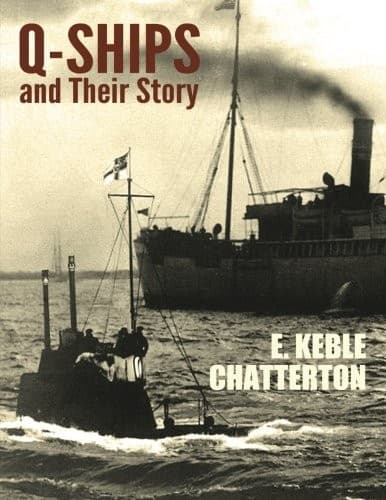
Q-Ships and Their StoryChatterton, E. Keble (Edward Keble)
History
Q-Ships and Their Story
Chatterton, E. Keble (Edward Keble)
Q-ships; World War, 1914-1918 -- Naval operations
The next incident occurred a week later. At ten minutes to six on the
morning of July 7 _Tenby Castle_ was lying off the western entrance
of the West Fjord, the weather being thick and rainy, when a large
steamer was seen to the N.N.W., so _Tenby Castle_ put on full speed
and ordered her to stop. This was the Swedish S.S. _Malmland_, with
about 7,000 tons of magnetic ore. After being ordered to follow the
trawler, Malmland put on full speed and drew ahead; so she was made to
keep right astern at reduced speed, and just before half-past eight
that morning was handed over to H.M.S. _India_ of the above-mentioned
cruiser squadron. The day passed, and it was a few minutes after
midnight when this trawler, again lying off the West Fjord, sighted a
steamer coming down from Narvik. A shot was fired across the steamer’s
bows, and on rounding-to under the steamship’s stern it was observed
that she was the German S.S. _Frederick Arp_, of Hamburg. She was
ordered to stop, then the trawler closed and ordered the steamer to
follow. The German refused to obey and steamed towards the land, so
the _Tenby Castle_ was compelled to fire a shot into his quarter, and
this caused him to stop. After he had several times refused to follow,
Lieutenant Randell gave him five minutes and informed him he would
either have to accompany the trawler or else be sunk. The five minutes
passed, the obstinate German still declined, and two minutes later put
his engines ahead and made towards the shore. It was now an hour since
the ship had first been sighted, so there was nothing for it but for
the trawler to sink her, and she was shelled at the water-line and sunk
four and a half miles away from the nearest land, her crew of thirteen
being handed over a few hours later to H.M.S. _India_. Thus a cargo of
4,000 tons of magnetic ore was prevented from reaching Germany.
Now, it was quite obvious that the information of these incidents would
not be long in reaching Germany from an agent via Norway. The German
Captain Gayer has stated since the war that news reached Germany that
‘an English auxiliary cruiser was permanently stationed’ off West
Fjord, whose task, he says, was ‘to seize and sink the German steamers
coming with minerals from Narvik.’ Therefore, on August 3, Germany
despatched U 22 from Borkum to West Fjord, and this craft had scarcely
taken up her position when she saw the armed merchant cruiser _India_
enter West Fjord and torpedoed her at long range, so that _India_ was
sunk. Gayer, who occupied during the war a high administrative position
in the U-boat service, adds the following statement: ‘It was,’ he
remarks, ‘one of the few instances in which a submarine found with
such precision the object of attack really intended for it, when the
information had been given by an agent.’
Public-domain text, read in full here on John Shaqi.
Reviews
Reviews
No reviews yet
Be the first to share your thoughts on this work.
Elsewhere in the archive
Join the Discussion
Join the discussion
Sign in to leave a comment or review.
Sign InorCreate an account