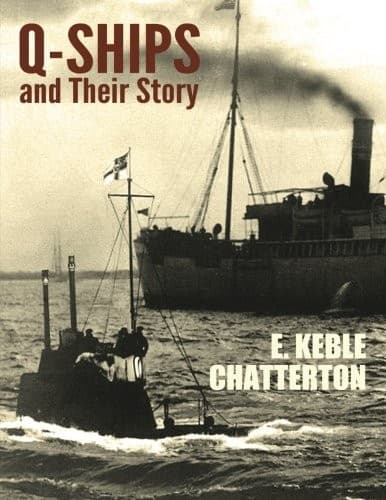
Q-Ships and Their StoryChatterton, E. Keble (Edward Keble)
History
Q-Ships and Their Story
Chatterton, E. Keble (Edward Keble)
Q-ships; World War, 1914-1918 -- Naval operations
We pass over the intervening years and come to February, 1918. On the
nineteenth of that month the Q-ship _Tay and Tyne_ had left Lerwick, in
the Shetlands, to perform similar work off the Norwegian coast, where
she arrived on the twenty-second. This was a little 557-ton steamer,
which had been requisitioned at the end of the previous July and fitted
out at Lowestoft with a 4-inch gun aft, suitably hidden, and a couple
of 12-pounders. She was a single-screw ship, built at Dundee in 1909,
having a funnel, two masts, and the usual derricks. In addition to her
guns she carried one torpedo tube and also smoke-making apparatus.
She was commanded by Lieutenant Mack, R.N., with whom Lieutenant G.
H. P. Muhlhauser, R.N.R., went as second in command, both of these
officers, as the reader will remember, having served together in the
Q-sailing-ship _Result_. Having commissioned the new ship, Lieutenant
Mack then took her from Lowestoft to the secluded area of the Wash in
order to practise gunnery and the ‘panic’ party arrangements. Months
passed, but on February 22 something of interest happened, for some
distance below the Vigten Islands a couple of steamers were sighted,
so course was then altered to cut off the one that was bound to the
southward. When 1,000 yards away the latter hoisted German colours,
so _Tay and Tyne_ (alias _Cheriton_ and _Dundreary_) hoisted the
international signal ‘M.N.’ to stop immediately. This ship was the
_Dusseldorf_, a nine-year-old, typical German flush-decked tramp
of 1,200 tons, with 1,700 tons of magnetic ore on board. As she
disregarded the signal, a shell was fired across her bows, and this
caused her to stop and hoist the answering pennant. Lieutenant Mack
then steamed round the stern, keeping her covered all the time with his
gun, and now took up station inshore of the German.
_Dusseldorf_ had been completely taken by surprise, and never supposed
that this little steamer could possibly be a trap-ship. _Tay and
Tyne_ lowered a boat containing several of the British crew, under
Lieutenant Muhlhauser, armed with revolvers and rifles, and this guard
then boarded the enemy, on board whom were found a couple of Norwegian
Customs House officials and two Norse pilots. Lieutenant Muhlhauser
then ordered the German captain to muster his crew, which he promptly
did, and now the terrified crew were given five minutes to collect
their clothes. The captain handed over the ship’s papers and protested
that the ship was in territorial waters. Eleven Germans and the four
Norwegians were then transferred to the Q-ship, who landed the four
Norwegians in the _Dusseldorf’s_ boat at Sves Fjord, and this boat
they were allowed to keep. The British boarding party had consisted of
a dozen men, but Lieutenant Muhlhauser sent three back to the Q-ship,
and retained three German stokers and the two German engineers in order
to get the prize back to England, these five men working under the
supervision of one of the _Tay and Tyne’s_ crew.
Public-domain text, read in full here on John Shaqi.
Reviews
Reviews
No reviews yet
Be the first to share your thoughts on this work.
Elsewhere in the archive
Join the Discussion
Join the discussion
Sign in to leave a comment or review.
Sign InorCreate an account