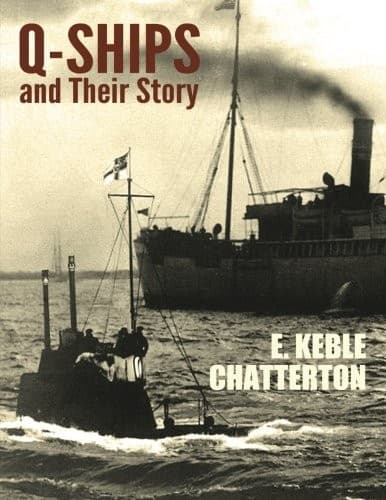
Q-Ships and Their StoryChatterton, E. Keble (Edward Keble)
History
Q-Ships and Their Story
Chatterton, E. Keble (Edward Keble)
Q-ships; World War, 1914-1918 -- Naval operations
large volume of smoke and steam escaping, and then she disappeared for
the last time very rapidly, stern first, Ober-Leutnant Crompton and the
helmsman escaping through an open hatchway.
After she had sunk finally a large burst of air and oil-fuel rose to
the surface, the submarine’s bulkheads having apparently burst owing
to the pressure due to the deep water, which here was 75 fathoms.
Only Crompton and the helmsman were saved, the former having been
badly wounded whilst entering the conning-tower. All the others,
consisting of five officers and twenty-five men, were lost. In the
meantime _Urbino_ had sunk, too, from her shell-holes, and _Baralong_
picked the whole crew up from their boats to the number of forty-two
officers and men, her master, Captain Allanson Hick, stating that his
ship was on her way from New York to Hull. _Baralong_, conscious of
having obtained another brilliant and brave victory, now proceeded with
her survivors to Falmouth, where she arrived in the early hours of
the following morning. Lieut.-Commander Wilmot-Smith was awarded the
D.S.O., and Temporary Engineer J. M. Dowie, R.N.R., received a D.S.C.,
a well-deserved decoration; for much depended on the engineers in these
ships, and they had much to suffer. Two of the crew received a D.S.M.
each, and the sum of £1,000 was also awarded, this being additional to
the bounty subsequently awarded in the Prize Court.
At this stage in the world’s history there is no intention of exulting
in the discomfiture and pain of the enemy. Day after day during this
period the writer used to see the sad sight of our survivors without
ship or belongings other than the clothes on their backs. It is
difficult altogether to forget these incidents or the unchivalrous
behaviour of the enemy. Without wishing to be vindictive, it is well
to place on record that the nineteen German sailors on the deck of
U 41 all jeered at Captain Hick in his distress, and yet although a
callous enemy had been sunk in a fair fight, this second _Baralong_
incident aroused in Germany a wave of horrified indignation akin to the
decoy’s former exploit. The German Press referred to the sinking of
U 41 as a murderous act, but if this were so there were to be plenty
more to follow. Happily, at last, we had found a real, effective means
of grappling with the submarine problem. Against us were contending
the finest brains of the German Navy, and these determined officers
were not over anxious to save life, as we knew from their behaviour at
the sinking of _Falaba_ and _Lusitania_. Such craft as U 41, over 200
feet long, with a maximum surface speed of 14 knots, but an endurance
of 5,500 miles at 10 knots, armed with a couple of guns and eight
torpedoes, were formidable foes, and any clever stratagem that could
be used against them, without infringing International Law, was surely
entirely justified. Thus, very wisely, four colliers were fitted
out that same autumn as Q-ships, these being the _Thornhill_ (alias
Public-domain text, read in full here on John Shaqi.
Reviews
Reviews
No reviews yet
Be the first to share your thoughts on this work.
Join the Discussion
Join the discussion
Sign in to leave a comment or review.
Sign InorCreate an account