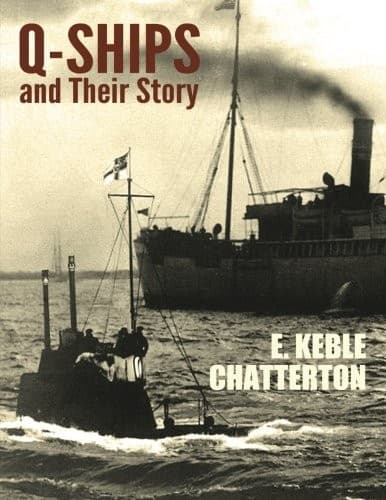
Q-Ships and Their StoryChatterton, E. Keble (Edward Keble)
History
Q-Ships and Their Story
Chatterton, E. Keble (Edward Keble)
Q-ships; World War, 1914-1918 -- Naval operations
11.10 a.m., this smoke screen being a favourite ruse for escaping, and
she was never seen again that day. _Werribee_ now turned her attention
to the torpedoed ship, but the latter was too far gone, and foundered
at 5.45 that afternoon. The men in _Springwell’s_ boats were then
picked up, and about 6 o’clock the ship made for Malta. It was again
sheer bad luck; a combination of difficult circumstances, and the
tactics of an astute German captain, had now prevented success coming
to the decoy. There was no question about her disguise, and the captain
of a merchantman who witnessed the fight accurately spoke of _Werribee_
as ‘an old tramp with a few patches of paint, firing at the submarine.’
Before the war we should have thought no ship in His Majesty’s Service
could possibly merit such a description as this, but strange things
were happening on the seas at this time, and it was the highest
compliment so to be described.
[Illustration:
FIG. 4.—DIAGRAM TO ILLUSTRATE APPROXIMATE MOVEMENTS OF ‘WERRIBEE’ IN
ACTION WITH SUBMARINE ON FEBRUARY 9, 1916.]
With the experience which had been gained from all these engagements
in various areas it was possible to form some idea of the requisite
standardized equipment with which Q-ships should be supplied. First of
all, inasmuch as the enemy was being better armed, at least one modern
4-inch gun was necessary, in addition to any 12-pounder. Long-range
action, especially in the Mediterranean, was probable at times, for
the enemy would not always consent to engage close to. Secondly,
it was highly important that the ship should remain afloat, even
though seriously holed. It might happen—and later on it actually did
occur—that the enemy might suppose the ship was just about to founder,
thus making it quite safe to close her in order to read her name. Then
would come the one great chance for the Q-ship to destroy the enemy.
Therefore, to this end, it became certain that these ships should be
given cargoes of barrels, or timber, carefully stowed, so that it would
be no easy task to sink her, and she might perhaps even be salved.
CHAPTER IV
THE STORY OF THE ‘FARNBOROUGH’
Public-domain text, read in full here on John Shaqi.
Reviews
Reviews
No reviews yet
Be the first to share your thoughts on this work.
Join the Discussion
Join the discussion
Sign in to leave a comment or review.
Sign InorCreate an account