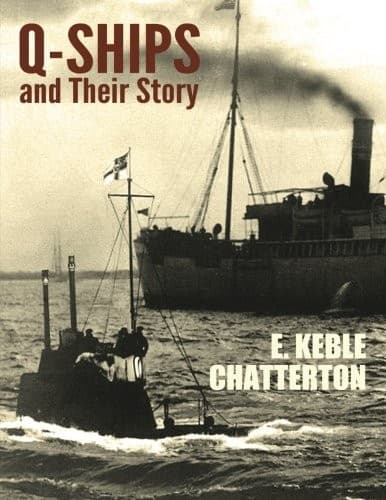
Q-Ships and Their StoryChatterton, E. Keble (Edward Keble)
History
Q-Ships and Their Story
Chatterton, E. Keble (Edward Keble)
Q-ships; World War, 1914-1918 -- Naval operations
_Helgoland_ had been built in 1895 of steel and iron at Martenshoek
in Holland, where they specialize in this kind of construction, but
she was now British owned and registered at Plymouth. She measured 122
feet 9 inches long, 23 feet 3 inches beam, drew 8 feet aft, and her
tonnage was 310 burthen and 182 net. In July, 1916, this ship was lying
in Liverpool undergoing an extensive overhaul, and here she was taken
over from her owners and sent to Falmouth, where she was fitted out
forthwith as a Q-ship. Armed with four 12-pounders and one Maxim, she
was known officially in future under the various names of _Helgoland_,
_Horley_, _Brig_ 10, and Q 17. Her crew were carefully chosen from the
personnel serving in Auxiliary Patrol vessels at Falmouth, with the
exception of the guns’ crews; the ship’s complement consisting of two
R.N.R. officers, one skipper, one second hand, two petty officers, six
Royal Navy gunnery ratings, eight deckhands of the Trawler Reserve, one
carpenter, one steward, and one cook, the last three being mercantile
ratings. Of her two officers one was Temporary Sub-Lieutenant W. E. L.
Sanders, R.N.R., who, by reason of his sailing-ship experience, was
appointed as mate. This was that gallant New Zealander who had come
across the ocean to help the Motherland, performed amazing service
in Q-ships, fought like a gentleman, won the Victoria Cross, and
eventually, with his ship and all his crew, went to the bottom like the
true hero that he was. The story must be told in a subsequent chapter.
When we consider the actions fought by these topsail schooners and
brigantines in the Great War we appear almost to be dreaming, to be
sent right back to the sixteenth century, and modernity seems to have
been swept clean away. While the Grand Fleet was unable, these sailing
ships were carrying on the warfare for which they had never been
built. In the whole of the Royal Navy there were hardly any suitable
officers nowadays who possessed practical experience in handling
schooners. This was where the officer from the Mercantile Marine, the
amateur yachtsman, the coasting skipper, and the fisherman became so
invaluable. In these days of decaying seamanship, when steam and motors
are dominant, it is well to set these facts down lest we forget. The
last of the naval training brigs has long since gone, and few officers
or men, even in the Merchant Service, serve an apprenticeship under
sail.
Public-domain text, read in full here on John Shaqi.
Reviews
Reviews
No reviews yet
Be the first to share your thoughts on this work.
Join the Discussion
Join the discussion
Sign in to leave a comment or review.
Sign InorCreate an account