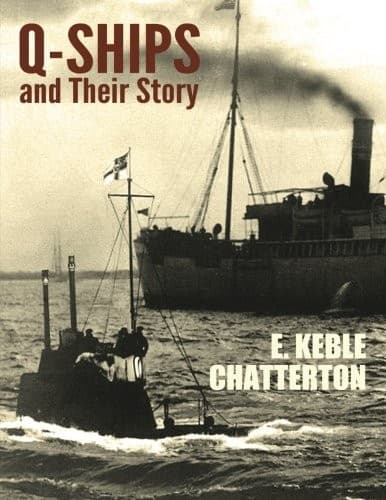
Q-Ships and Their StoryChatterton, E. Keble (Edward Keble)
History
Q-Ships and Their Story
Chatterton, E. Keble (Edward Keble)
Q-ships; World War, 1914-1918 -- Naval operations
It was in January, 1917, that she had an experience which showed the
fine seamanship and sound judgment which were essential in the captain
of such a secret ship. His name was Lieutenant John Lawrie, R.N.R., a
man of strong personality, a real sailor, and possessed of valuable
initiative. On the evening of January 7, _Mitchell_ was off Berry Head,
just east of Dartmouth, when bad weather came on, and this developed
into a strong winter’s gale. There was every reason why a Q-ship
should not run into the nearest port for shelter, as her presence
would lead to awkward questions, whereas secrecy was the essence
of her existence. The gale blew its fiercest, and by the following
night _Mitchell_ was having an alarming time. Just after 9.30 p.m the
foremast and spars crashed over the side, carrying away her mainmast
too. She then lay-to under close-reefed mizzen. A jurymast was rigged
on the stump of the foremast, and the wind, having veered from W.
through N.W. to N.E., she was able to set a reefed stay-sail. It was
still blowing a strong gale, with what Lieutenant Lawrie described
as a ‘mountainous sea’ running, and she drifted before the gale in a
south-west direction towards Ushant.
In this predicament it was time to get assistance if possible, and
about 9.15 on the morning of the 9th she signalled a large cargo
steamer, who endeavoured to take _Mitchell_ in tow, but eventually had
to signal that this was impossible, and continued steaming on her way
up Channel. The schooner was now about ten miles north of Ushant, an
anxious position for any navigator going to leeward, but Lieutenant
Lawrie considered she would drift clear. The north-east gale showed
no sign of easing up during that evening. Signals of distress were
made, a gun being fired every few minutes as well as rocket distress
signals, and flares were kept burning; but no answering signal came
from the shore. By this time the schooner was getting dangerously
near to Ushant, and it could not be long before she and her crew
would inevitably perish. However, she never struck, and at 9.30 p.m.
the Norwegian S.S. _Sardinia_ spoke her and stood by throughout the
terrible night until 7 a.m. of the 10th. Then ensued a nice piece
of seamanship when the steamer lowered into the sea a buoy with a
small line attached. This _Mitchell_ managed to pick up, and the
tow-line was made fast. _Sardinia_ then went ahead and towed her from
a position 10 miles west (True) of Creach Point until 11.15 a.m. when
near Les Pierres Light. Here a French torpedo-boat came towards them,
so Lieutenant Lawrie hoisted the Red Ensign; but having done that he
was clever enough also to show the White Ensign over the stern and in
such a manner that the Norwegian was unable to see it. The captain of
the French torpedo-boat at once understood, signalled to the Norwegian
to cast off and that the torpedo-boat would take the schooner in tow.
This was done at noon, and the _Sardinia_ was informed that the name of
Public-domain text, read in full here on John Shaqi.
Reviews
Reviews
No reviews yet
Be the first to share your thoughts on this work.
Join the Discussion
Join the discussion
Sign in to leave a comment or review.
Sign InorCreate an account