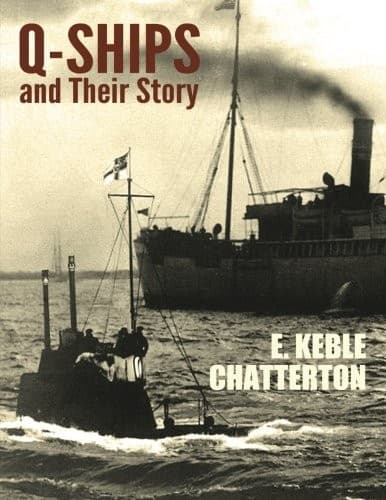
Q-Ships and Their StoryChatterton, E. Keble (Edward Keble)
History
Q-Ships and Their Story
Chatterton, E. Keble (Edward Keble)
Q-ships; World War, 1914-1918 -- Naval operations
The reader will have noted the preliminary methods of attack on the
part of the submarine and his manner of varying his position. He
divided his attack into two. The first was the approach, the second
was the attack proper. The former was made at a distance of 12,000
yards, and during this time he was using his high-power, long-range
periscope, manœuvring into position, and ascertaining the course and
speed of the on-coming Q-ship. The attack proper was made at 800 or
400 yards, and for this purpose the short-range periscope was used.
Now watch the U-boat in his attempt to kill. He is to rely this time
not on long-range shelling, but on the knock-out blow by means of his
torpedo: he has endeavoured, therefore, to get about four points on
the Q-ship’s bow, for this is the very best position, and he has dived
to about 60 feet. During the approach his torpedo-tubes have been got
ready, the safety-pins have been removed, and the bow caps of the tubes
opened. The captain has already ascertained the enemy’s speed and the
deflection or angle at which the torpedo-tube must point ahead of the
Q-ship at the moment of firing. When the enemy bears the correct number
of degrees of deflection the tube is fired, the periscope lowered,
speed increased, and, if the torpedo has hit the Q-ship, the concussion
will be felt in the submarine. This depends entirely on whether the
Q-ship’s speed and course have been accurately ascertained. The torpedo
has travelled at a speed of 36 knots, so, knowing the distance to be
run, the captain has only to look at his stop-watch and reckon the
time when his torpedo should have hit. If the German was successful
he usually hoisted his periscope and cruised under the stern of the
ship to obtain her name. If he were an experienced officer he never
came near her, after torpedoing, unless he was quite certain she was
abandoned and that she was not a trap. During 1917 and onwards, having
sunk the Q-ship, the submarine would endeavour to take the captain
prisoner, and one Q-ship captain, whose ship sank underneath him, found
himself swimming about and heard the U-boat’s officer shouting to the
survivors, ‘Vere is der kapitan?’ but the men had the good sense
to lie and pretend their skipper was dead. After this the submarine
shoved off, and my friend took refuge with others in a small raft.
But frequently a submarine would wait a considerable time cruising
round the sinking ship, scrutinizing her, examining the fittings, and
expecting to find badly hinged bulwarks, a carelessly fitted wireless
aerial, a suspicious move of a ‘deckhouse’ or piece of tarpaulin hiding
the gun. This was the suspense which tried the nerves of most Q-ship
crews, especially when it was followed by shelling.
Public-domain text, read in full here on John Shaqi.
Reviews
Reviews
No reviews yet
Be the first to share your thoughts on this work.
Elsewhere in the archive
Join the Discussion
Join the discussion
Sign in to leave a comment or review.
Sign InorCreate an account