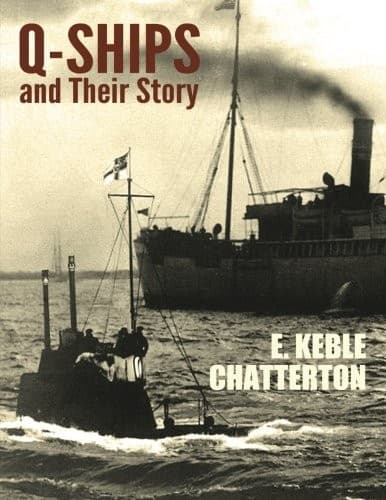
Q-Ships and Their StoryChatterton, E. Keble (Edward Keble)
History
Q-Ships and Their Story
Chatterton, E. Keble (Edward Keble)
Q-ships; World War, 1914-1918 -- Naval operations
Seen with only two masts, the mizzen having been lowered. The crew’s
washing is displayed as in a tramp steamer. The funnel has been
painted a different colour. But behind the white wind screen on the
lower bridge is a 6-pounder gun—one each side—which can fire from
ahead to astern. Inside the boat on the main hatch just forward of
the funnel is the dummy boat in which a 12-pounder is concealed. Two
3-pounders are in the after deck-house. Depth charges were released
through ports in the counter.
To face p. 116]
After only ten minutes’ engagement the submarine foundered, bows
first, but not before _Penshurst’s_ boats had taken off the survivors
and also those who had leapt into the sea. These survivors included
Ober-Leutnant Erich Noodt, Leutnant Karl Bartel, Ingenieur-Aspirant
Eigler, and thirteen of the crew; but seven had been killed. Thus
perished UB 19, who had left Zeebrugge on November 22, having come via
the Straits of Dover. She was about 118 feet long, painted grey, had
the one gun, two periscopes, and had been built the year previous.
She was of the smaller class of submarines belonging to the Flanders
flotilla which operated for three weeks on end in the waters of the
English Channel, carrying only three torpedoes, one of which had
already been used to sink a Norwegian ship. It was learned from her
crew that her submerged speed was about 4 knots; so Captain Grenfell,
but for the accident to the sea-plane, would have been able to get
right over her and destroy her by depth charge.
Thus, at length, after a year of hard work, disappointment, and all
kinds of weather, Commander Grenfell, by his doggedness and downright
skill, had scored his first success. The King rewarded him with a
D.S.O., another officer received the D.S.C., and one of the crew the
D.S.M. The ship’s complement consisted of Commander Grenfell, three
temporary (acting) R.N.R. lieutenants, and one assistant paymaster,
who was engaged during the action in taking notes. The crew numbered
fifty-six, which included R.N.R. and R.N.V.R. ratings. The sum of
£1,000 was awarded to the ship, and, after the war, Lord Sterndale in
the Prize Court awarded a further sum as prize bounty.
Public-domain text, read in full here on John Shaqi.
Reviews
Reviews
No reviews yet
Be the first to share your thoughts on this work.
Elsewhere in the archive
Join the Discussion
Join the discussion
Sign in to leave a comment or review.
Sign InorCreate an account