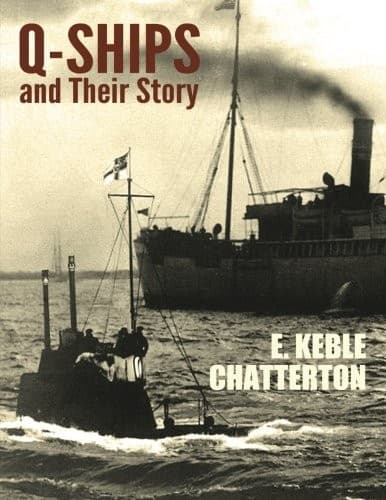
Q-Ships and Their StoryChatterton, E. Keble (Edward Keble)
History
Q-Ships and Their Story
Chatterton, E. Keble (Edward Keble)
Q-ships; World War, 1914-1918 -- Naval operations
The gallant _Penshurst_ had not long to wait for her next adventure.
December passed, and on January 14, 1917, there was another and newer
UB boat ready for her. It was ten minutes to four in the afternoon,
and the Q-ship was in Lat. 50.9 N., Long. 1.46 W.—that is to say,
between the Isle of Wight and Alderney, when she saw a submarine
heading towards her. Five minutes later, the German, when 3,000 yards
off, fired, but the shot fell short. The Q-ship then stopped her
engines, went to ‘panic’ stations, and sent away her boats with the
‘abandon ship’ party. _Penshurst_ then gradually fell off to port,
and lay with her head about W.N.W., bringing the submarine on the
starboard bow. Closing rapidly on this bearing, the UB boat kept firing
at intervals, and when about 700 yards off turned as though to cross
Captain Grenfell’s bows. The latter withheld his fire, thinking the
enemy was going round to the boats on the port quarter, and he would
be able to get her at close range. But the German stopped in this
position, exposing her broadside, and quickened her rate of fire,
hitting the steamer twice in succession. It was this kind of experience
which always tested the discipline and training of the Q-ship, as a
well-trained boxer can receive punishment without losing his temper,
knowing his chance will come presently.
[Illustration: FIG. 11.—DIAGRAM TO ILLUSTRATE APPROXIMATE MOVEMENTS OF
‘PENSHURST’ IN HER ACTION WITH SUBMARINE ON JANUARY 14, 1917.]
The first hit broke an awning ridge-pole on _Penshurst’s_ bridge,
the second shell struck the angle of the lower bridge, severing
the engine-room telegraph connections and the pipe connecting the
hydraulic release gear, by means of which the depth charge aft could
be let go from the bridge. This shell also killed the gun-layer and
loading-number of the 6-pounder, wounding its breech-worker and the
signalman who was standing by to hoist the White Ensign. So at 4.24
p.m. _Penshurst_ opened fire, her first shot from the 12-pounder
hitting the base of the enemy’s conning-tower and causing a large
explosion, as though the ammunition had been exploded. Large parts of
the conning-tower were seen to be blown away, and a big volume of black
smoke arose. The second British shot from this gun hit the enemy a
little abaft the conning-tower and also visibly damaged the hull. The
starboard 3-pounder hit the lower part of the conning-tower at least
four times, and then the enemy sank by the stern. _Penshurst_ wanted to
make sure, so steamed ahead and dropped depth charges over her, then
picked up her boats and made for Portland, where she arrived at ten
o’clock that evening and sent her wounded to the Naval Hospital. It
had been another excellent day’s work, for UB 37, one of those modern
craft fitted with net-cutters forward for the purpose of cutting a
way through the Dover Straits barrage, had been definitely destroyed
without a single survivor. More rewards followed, and, later on, more
prize bounty.
Public-domain text, read in full here on John Shaqi.
Reviews
Reviews
No reviews yet
Be the first to share your thoughts on this work.
Elsewhere in the archive
Join the Discussion
Join the discussion
Sign in to leave a comment or review.
Sign InorCreate an account