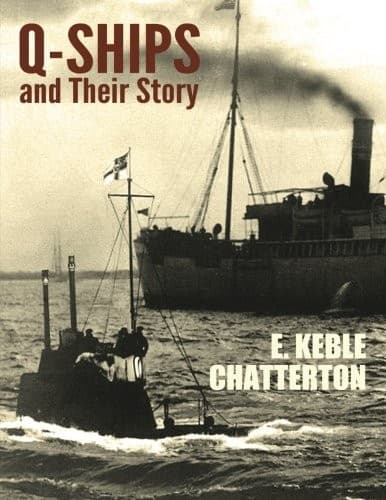
Q-Ships and Their StoryChatterton, E. Keble (Edward Keble)
History
Q-Ships and Their Story
Chatterton, E. Keble (Edward Keble)
Q-ships; World War, 1914-1918 -- Naval operations
_Penshurst_ resumed her cruising, and just about a month later she
was in the western approach to the English Channel, the exact date
being February 20, and the position Lat. 49.21 N., Long. 6.16 W. At
12.36 p.m. a German submarine rose to the surface, and a quarter of
an hour later began firing at a range of 3,000 yards. _Penshurst_
then ‘abandoned’ ship, and at 1.4 p.m. opened fire and scored a hit
with her 6-pounder. At 100 yards range the other guns came into
action, and the enemy was hit above the waterline in the centre of the
conning-tower and abaft this superstructure. She then submerged and was
depth-charged; yet this submarine, in spite of all this, was not sunk.
This again illustrated the statement already made that a submarine
could be severely holed and yet be able to get back home. A still more
illuminating example is to be found in the following incident.
Only two days had elapsed and _Penshurst_ was again busily engaged. It
was at 11.34 a.m., February 22, and the ship was off the south coast
of Ireland, the exact position being Lat. 51.56 N., Long. 6.46 W.
_Penshurst_ was steering S. 89 W. when she saw a submarine steering
west. The steam-ship therefore steamed at her utmost speed, but could
not get up to her, for we may as well mention that this was U 84, a
very up-to-date submarine which had a surface speed of 16 knots and
could do her 9 knots submerged for a whole hour. It is not to be
wondered, therefore, that she could run away from this slow steamer and
at 11.55 a.m. disappear. At this time there was in sight 8 miles away
H.M.S. _Alyssum_, one of Admiral Bayly’s sloops based on Queenstown,
who was escorting the large four-masted S.S. _Canadian_. As _Penshurst_
proceeded, she sighted at 12.18 p.m. a boat with men in it, these being
from the torpedoed sailing ship _Invercauld_, which had been sunk 22
miles S.E. of Mine Head, Ireland, that same day. A few minutes later
and _Penshurst_ observed the keel of this ship floating bottom up. At
12.35 the periscopes of U 84 were seen to emerge 400 yards on the port
beam, and the track of a torpedo making straight for the midships of
_Penshurst_. By at once starboarding the helm, disaster was avoided,
but the torpedo passed as close as 15 feet.
[Illustration: Q-SHIP “PENSHURST”
In this dummy boat mounted on the main hatch is seen hidden the
12-pounder gun. The sides of the boat were movable. The voice pipe from
the bridge to the two after guns was lashed to the derrick and thus
hidden from the enemy.]
[Illustration: Q-SHIP “PENSHURST”
Public-domain text, read in full here on John Shaqi.
Reviews
Reviews
No reviews yet
Be the first to share your thoughts on this work.
Elsewhere in the archive
Join the Discussion
Join the discussion
Sign in to leave a comment or review.
Sign InorCreate an account