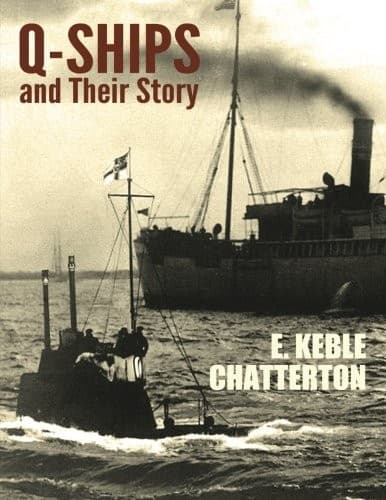
Q-Ships and Their StoryChatterton, E. Keble (Edward Keble)
History
Q-Ships and Their Story
Chatterton, E. Keble (Edward Keble)
Q-ships; World War, 1914-1918 -- Naval operations
On July 2 she was steaming her 8 knots, as usual, and was in the
western approaches (Lat. 49.10 N., Long. 8.25 W.), when at 1.30 p.m. a
submarine was seen crossing the ship’s bows 6,000 yards away. She dived
and waited for _Penshurst_ to approach in the manner of attack outlined
in a previous chapter as being the tactics of a submarine. Then, after
a while, the periscope was sighted 500 yards away on the port beam, so
_Penshurst_, knowing a torpedo was imminent, waited, and, the torpedo
having been sent, altered course to avoid it, just missing by a matter
of 10 feet. The ship’s company then went to ‘panic’ stations and the
ship was ‘abandoned.’ At 3.35 p.m. the enemy came to the surface
5,000 yards away on the starboard quarter, at 3.39 p.m. opened fire
and continued until 4.13 p.m., when _Penshurst_ herself started firing
at 4,500 yards, succeeding in hitting the enemy sixteen times, and
undoubtedly seriously damaging him. The submarine managed to pass out
of range and was not sunk. Three destroyers now came on the scene and
gave chase, but the German got away. For this engagement Lieutenant
Naylor received the D.S.O.
In accordance with _Penshurst’s_ previous experience, not many weeks
elapsed before she was again in combat. It was the following August 19,
and she was cruising again in the western approaches. That morning a
steamship had sighted a submarine, and _Penshurst_, who was now in Lat.
47.45 N., Long. 8.35 W., was steering S. 50 W., doing 8 knots, when she
saw the enemy 6 miles ahead steering across the bows, evidently making
the ‘approach’ in his tactics. There was little north-west wind, a
moderate westerly swell, and the sky was clear, but there was a strong
glare from the sun. At 5.8 p.m. the enemy dived, and Lieutenant Naylor
estimated that she would probably attack with torpedo about 5.45 p.m.
Exactly at 5.44 a torpedo was observed to break water 1,000 yards from
the ship, 3 points on the starboard bow, just forward of the sun’s
rays. _Penshurst_ put her helm hard aport, and at 5.45 the torpedo
struck her—but fortunately it was only a glancing blow immediately
below the bridge. The smart handling of the ship had thus saved her
from being struck further aft, where the consequences would have been
even more serious. As it was, the explosion caused a high volume of
water to rise in such quantities that upper and lower bridges and after
deck were flooded, overwhelming the gun’s crew concealed there, and
filling the starboard boat hanging in the davits over 70 feet away from
the point of impact. Furthermore, it caused the ship to take a heavy
list to starboard so that the sea poured in over the bulwarks, and she
afterwards rolled to port, the water then pouring in on this side also.
Public-domain text, read in full here on John Shaqi.
Reviews
Reviews
No reviews yet
Be the first to share your thoughts on this work.
Elsewhere in the archive
Join the Discussion
Join the discussion
Sign in to leave a comment or review.
Sign InorCreate an account