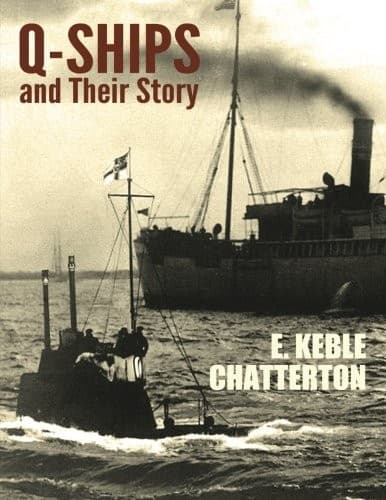
Q-Ships and Their StoryChatterton, E. Keble (Edward Keble)
History
Q-Ships and Their Story
Chatterton, E. Keble (Edward Keble)
Q-ships; World War, 1914-1918 -- Naval operations
Some of the crew were hurled with force against the ceiling of the
cabins, but perfect discipline still continued, as might well be
expected with such a well-tried crew. She had been torpedoed in No. 2
hold, the starboard side of the lower bridge had been stripped, and
unfortunately the 12-pounder there kept screened was thus exposed.
Unfortunately, too, the sides of the dummy boat amidships, which hid
another 12-pounder, were thrown down by the explosion, thus exposing
this gun, flooding the magazine, putting out of action all controls
from the bridge as well as the ship’s compasses and so on. What was to
be done now? Lieutenant Naylor wisely decided not to ‘abandon’ ship
since the guns had been disclosed; the ship could not be manœuvred so
as to hide this side, and the enemy would probably make another attack.
She was therefore kept under way, the steering gear was connected up
with the main steering engines, the wireless repaired, and at 5.58 a
general signal was sent out to H.M. ships requesting assistance.
[Illustration: FIG. 12.—THE HUMOROUS SIDE OF Q-SHIP WARFARE.
This amusing sketch of _Penshurst_, by one of her officers, shows
her being shelled by a submarine and the panic party in two boats
rowing off. In the bows of each boat one of the crew is semaphoring.
BILL (_in boat No. 1_): ‘’Arry!’ ’ARRY (_in boat No. 2_): ‘What?’
BILL (_anxiously_): ‘Did yer make the tea afore we left ‘er?’ ’ARRY:
‘Nar!’ BILL (_much relieved_): ‘Good!’]
At five minutes past six the submarine showed herself on the port
quarter 6,000 yards away. This made things better, for if the enemy
had not already observed the exposed guns she could still be kept
in ignorance, as the sides of the false boat had in the meantime
been replaced in position. Therefore the 3-pounder on the top of the
gunhouse aft opened fire at 5,000 yards. This was quite a normal
happening, for many a small mercantile steamer was thus armed
defensively. The enemy replied, and at 6.21, as the latter showed no
intention of decreasing the range, _Penshurst_ opened fire with all
guns on the port side, and appeared to hit, so that at 6.24 the enemy
submerged. Meanwhile the _Penshurst_ was not under control and steamed
round in circles, but help was approaching, for at 6.50 p.m. H.M.S.
_Leonidas_ wirelessed saying she would reach _Penshurst_ at 7.30 p.m.
At 7.5 the submarine was 7 miles astern, waiting stationary to see
what would happen, but at 7.26 she dived on observing the approaching
destroyer. Nightfall came, and as the water was still gaining in
the Q-ship, all the men who could be spared were transferred to the
_Leonidas_. _Penshurst_ then shaped a course E.N.E. for Plymouth, and
next day at 1.30 p.m. was taken in tow by a tug which had been sent out
with two armed trawlers from the Scillies Naval Base. Thus, wounded yet
not beaten, she passed through Plymouth Sound, and on August 21 made
fast to a Devonport jetty, happily having suffered no casualties to any
Public-domain text, read in full here on John Shaqi.
Reviews
Reviews
No reviews yet
Be the first to share your thoughts on this work.
Elsewhere in the archive
Join the Discussion
Join the discussion
Sign in to leave a comment or review.
Sign InorCreate an account