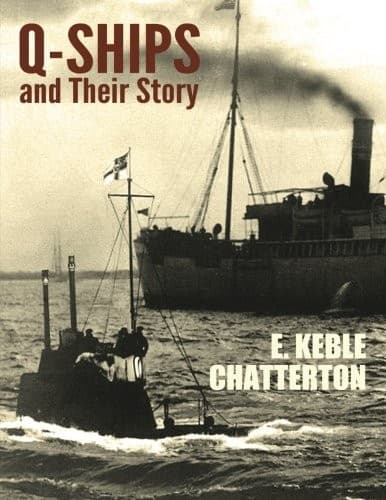
Q-Ships and Their StoryChatterton, E. Keble (Edward Keble)
History
Q-Ships and Their Story
Chatterton, E. Keble (Edward Keble)
Q-ships; World War, 1914-1918 -- Naval operations
Having regard to the increasing utility and efficiency of the Q-ships,
we can well understand Admiral Scheer’s objection to U-boats rising
to the surface, examining the ship’s papers, and allowing everyone to
leave the ship before sinking her. This was the recognized law, and
entirely within its rights the Q-ship made full use of this until she
hoisted the White Ensign and became suddenly a warship. It shows the
curious mental temper of the German that he would gamble only when he
had the dice loaded in his favour. He had his Q-ships, which, under
other names, endeavoured and indeed were able to pass through our
blockade, and go raiding round the world; but until his submarines
could go at it ruthlessly, he had not the same keenness. It was on
February 1, 1917, that his Unrestricted Submarine Campaign began,
and this was a convenient date, seeing that Germany had by this time
109 submarines. We know these facts beyond dispute, for a year after
the signing of Armistice Germany held a ‘General National Assembly
Committee of Inquiry’ into the war, and long accounts were published
in the Press. One of the most interesting witnesses was Admiral von
Capelle, who, in March, 1916, had succeeded von Tirpitz as Minister
of Marine; and from the former’s lips it was learned that one of the
main reasons why Germany in 1916 built so few submarines was the
Battle of Jutland; for the damage inflicted on the High Sea Fleet
necessitated taking workmen away from submarine construction to do
repairs on the big ships. The number and intensity of the minefields
laid by the British in German waters in that year caused Germany to
build many minesweepers to keep clear the harbour exits. This also,
he says, took men away from submarine building. It needed a couple of
years to build the larger U-boats and a year to build the smaller ones;
and though at the beginning of the Unrestricted Campaign in February,
1917, there were on paper 109 German submarines, and before the end
of the war, in spite of sinkings by Allied forces, the number even
averaged 127, yet there were never more than 76 actually in service
at one time, and frequently the number was half this amount. For the
Germans divided the seas up into so many stations, and for each station
five submarines were required, thus: one actually at work in the area,
one just relieved on her way home for rest and refit, a third on her
way out from refit to relieve number one, while two others were being
overhauled by dockyard hands. Geographically Germany was unfortunately
situated for attacking the shipping reaching the British Isles from the
Atlantic and Bay of Biscay. Before the submarines could get into the
Atlantic they had either to negotiate the Dover Straits or go round the
North of Scotland. The first was risky, especially for the bigger and
more valuable submarines, and during 1918 became even highly dangerous;
but the second, especially during the boisterous winter months, knocked
Public-domain text, read in full here on John Shaqi.
Reviews
Reviews
No reviews yet
Be the first to share your thoughts on this work.
Elsewhere in the archive
Join the Discussion
Join the discussion
Sign in to leave a comment or review.
Sign InorCreate an account