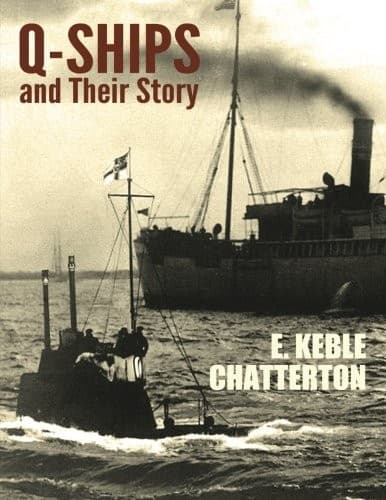
Q-Ships and Their StoryChatterton, E. Keble (Edward Keble)
History
Q-Ships and Their Story
Chatterton, E. Keble (Edward Keble)
Q-ships; World War, 1914-1918 -- Naval operations
One of the great lessons of the Great War was the inter-relation of
international politics and warfare. It was an old lesson indeed, but
modern conditions emphasized it once more. We have already seen that
the torpedoing in 1915 of the Atlantic liners _Lusitania_ and _Arabic_
caused pressure to be put on the German Government by the United States
of America. In the spring of 1916 the submarine campaign, for the
Germans, was proceeding very satisfactorily. In February they had sunk
24,059 tons of British merchant shipping, in March they sank 83,492
tons, in April 120,540 tons; but in May this dropped suddenly to 42,165
tons. What was the reason for this sudden fall?
The answer is as follows: On March 24, 1916, the cross-Channel S.S.
_Sussex_ was torpedoed by a German submarine, and it happened that
many citizens of the U.S.A. were on board at the time and several were
killed. This again raised the question of relations between the U.S.A.
and Germany, the _New York World_ going so far as to ask, ‘Whether
anything is to be gained by maintaining any longer the ghastly pretence
of friendly diplomatic correspondence with a Power notoriously lacking
in truth and honour.’ On April 20, therefore, the U.S.A. presented
a very sharp note to the German Government, protesting against the
wrongfulness of the submarine campaign waged versus commerce, and
threatened to break off diplomatic relations. The result of this was
that Germany had to give way, and sent orders to her naval staff to
the effect that submarine warfare henceforth was to be carried on in
accordance with Prize Law: that is to say, the U-boats—so Admiral
Scheer interpreted it—were ‘to rise to the surface and stop ships,
examine papers, and all passengers and crew to leave the ship before
sinking her.’
Now this did not appeal to the German mind at all. ‘As war waged
according to Prize Law by U-boats,’ wrote Admiral Scheer,[3] ‘in the
waters around England could not possibly have any success, but, on the
contrary, must expose the boats to the greatest dangers, I recalled
all the U-boats by wireless, and announced that the U-boat campaign
against British commerce had ceased.’ Thus we find that after April
26 the sinkings of British merchant ships became low until they began
to increase in September, 1916, and then rapidly mounted up until in
April, 1917, they had reached their maximum for the whole war with
516,394 tons. It is to be noted that after May 8, until July 5, 1916,
no sinkings by U-boats occurred in home waters, although the sinkings
went on in the Mediterranean, where risk of collision with American
interests was less likely to occur.
Public-domain text, read in full here on John Shaqi.
Reviews
Reviews
No reviews yet
Be the first to share your thoughts on this work.
Elsewhere in the archive
Join the Discussion
Join the discussion
Sign in to leave a comment or review.
Sign InorCreate an account