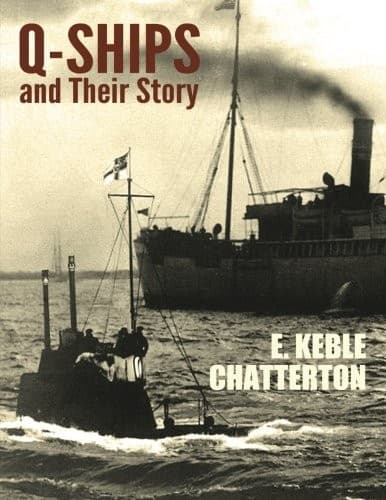
Q-Ships and Their StoryChatterton, E. Keble (Edward Keble)
History
Q-Ships and Their Story
Chatterton, E. Keble (Edward Keble)
Q-ships; World War, 1914-1918 -- Naval operations
In every port all over the country numerous passenger and tramp
steamers and sailing ships were inspected and found unsuitable owing
to their peculiar structure or the impossibility of effective disguise
combined with a sufficient bearing of the disguised guns. All this
meant a great deal of thought and inventive genius, the tonnage as
a rule ranging from 200 to 4,000, and the ships being sent to work
from Queenstown, Longhope, Peterhead, Granton, Lowestoft, Portsmouth,
Plymouth, Falmouth, Milford, Malta, and Gibraltar. And when you ask
what was the net result of these Q-ships, the whole answer cannot be
given in mere figures. Generally they greatly assisted the merchantman,
for it made the U-boat captain very cautious, and there are instances
where he desisted from attacking a real merchant ship for the reason
that something about her suggested a Q-ship. In over eighty cases
Q-ships damaged German submarines and thus sent them home licking their
wounds, anxious only to be left alone for a while. This accounts for
some of those instances when a merchant ship, on seeing a submarine
proceeding on the surface, was surprised to find that the German did
not attack. Thus the Q-ship had temporarily put a stop to sinkings by
that submarine. But apart from these indirect, yet no less valuable,
results, no fewer than eleven submarines were directly sent to their
doom of all the 203 German U-craft sunk during the war from various
causes, including mines and accidents.
But as time went on it became inevitable that the more a Q-ship
operated the more likely would she be recognized and the less useful
would be her work. By August, 1917, Q-ships were having a most
difficult time, and during that month alone six Q-ships were lost.
By September their success, broadly speaking, was on the wane. This,
however, does not mean that their service had ceased to be productive
or that they were no longer deemed worth while. On the contrary, as
we shall see presently, they were to perform more wonderful work, and
the number of Q-ships was actually increased, especially in respect
of sailing ships in home waters; but those which happened to make an
unsuccessful attack were at once ordered to return to their base and
alter both rig and disguise. Similarly, in the Mediterranean, where
the submarines were doing us so much harm, the number of Q-ships was
increased, and one was cleverly included in the outward-bound convoys,
to drop astern as soon as in the danger zone, after the manner of many
a lame-duck merchantman whose engines had caused him to straggle. Then
would come the Q-ship’s chance, when she revealed herself as a warship
and fooled the submarine from attacking the convoy, which had just
disappeared over the horizon in safety.
Public-domain text, read in full here on John Shaqi.
Reviews
Reviews
No reviews yet
Be the first to share your thoughts on this work.
Elsewhere in the archive
Join the Discussion
Join the discussion
Sign in to leave a comment or review.
Sign InorCreate an account