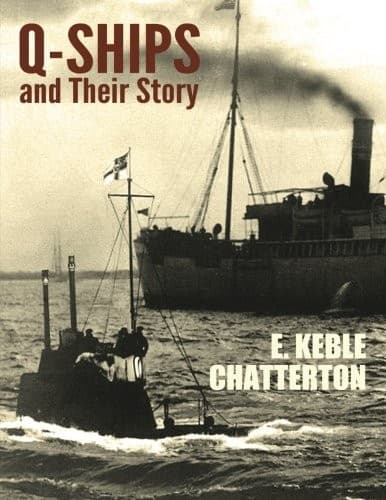
Q-Ships and Their StoryChatterton, E. Keble (Edward Keble)
History
Q-Ships and Their Story
Chatterton, E. Keble (Edward Keble)
Q-ships; World War, 1914-1918 -- Naval operations
The converted ‘flower’ class sloops, originally built as minesweepers,
but by the able work of the naval dockyard staff now made to resemble
little merchantmen, were having a busy time. _Tulip_ (Q 12), for
instance, which had begun her Q-ship service at the end of August,
1916, was sunk eight months later by a submarine in the Atlantic and
her captain taken prisoner, though eighty survivors were picked up by
the British destroyer _Mary Rose_ and landed in Queenstown.[4] The
sloop _Viola_ began this special work towards the end of September,
1916, and a month later was shelled by a submarine, who suddenly gave
up the attack and made off to the northward, having evidently realized
the sloop’s disguise, which none but an expert seafarer could have
penetrated. Now, in each submarine there was usually carried as warrant
navigating officer a man who had served in German liners and freighters
and would be familiar with the shipping normally to be found in the
area to which each U-boat was assigned. In this particular incident
his practised eye had evidently been struck by the position of the
above-water discharge being vertically under the imitation cargo hatch
and derrick forward of the mainmast. These were important details which
had to be watched if the disguise was to be successful.
[Illustration: Q-SHIP “TULIP”
This vessel was originally built as a sloop, but was given a false
stern and generally altered to resemble a merchantman.]
[Illustration: Q-SHIP “TAMARISK”
Like the “Tulip,” this vessel was originally built as a warship. She
was cleverly altered so that both in hull and upperworks she resembled
a merchant steamer.
To face p. 138]
Another converted sloop was _Tamarisk_, who began that rôle at the end
of July, 1916, and was commanded by Lieutenant John W. Williams, R.N.R.
Towards the end of November she was shelled by a submarine at long
range, so that the Q-ship had to declare herself and reply, whereupon
the enemy beat a retreat and dived. Hitherto the excellent Q-ship
gunnery had depended on the fact that first-class men had been selected
who would be able at short range to score hits with the first or second
rounds. But this incident of the _Tamarisk_, involving at least 6,000
yards range, showed that a small range-finder would be very useful, and
this was accordingly supplied. Other sloops thus converted to resemble
merchantmen were the _Begonia_, _Aubrietia_, _Salvia_, _Heather_, and
so on.
Public-domain text, read in full here on John Shaqi.
Reviews
Reviews
No reviews yet
Be the first to share your thoughts on this work.
Elsewhere in the archive
Join the Discussion
Join the discussion
Sign in to leave a comment or review.
Sign InorCreate an account