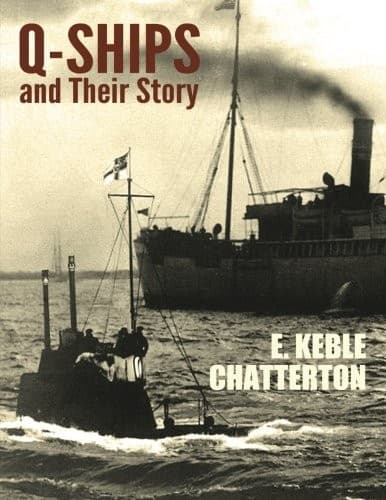
Q-Ships and Their StoryChatterton, E. Keble (Edward Keble)
History
Q-Ships and Their Story
Chatterton, E. Keble (Edward Keble)
Q-ships; World War, 1914-1918 -- Naval operations
In the summer of 1914 I happened to be on a yachting cruise in the
English Channel. In July we had seen the Grand Fleet, led by _Iron
Duke_, clear out from Weymouth Bay for Spithead. In single line ahead
the battle squadrons weighed and proceeded, then came the light
cruisers, and before the last of these had washed the last ounce
of dirt off her cable and steamed into position, the _Iron Duke_
and _Marlborough_ were hull down over the horizon: it was the most
wonderful sight I had ever witnessed at sea. A week or two later I had
arrived in Falmouth, the war had begun, and yachting came to a sudden
stop. One morning we found a new neighbour had arrived, a typical,
foreign-built, three-masted schooner, who had just been brought in and
anchored. She was destined to be an historic ship in more ways than
one. Actually, she was the first prize to be captured from Germany, and
it was a unique sight then to see the White Ensign flying over German
colours. Within four or five hours of declaration of war this craft had
been captured at the western entrance of the English Channel, and she
never became German again.
But she was to be historic in quite another way. Of all the splendid
little Q-ships during the war, not excepting even the _Mitchell_
mentioned in another chapter, no sailing craft attained such
distinction, and her captain will be remembered as long as British
naval history has any fascination. This German schooner was named the
_Else_, and had been built of steel and iron in 1901 at Westerbrock,
by the firm of Smit and Zoon, but registered at Leer, Germany. She was
112 feet 6 inches long, her net tonnage being 199. I can still see her
disconsolate German skipper standing aft, and it must have grieved
him that his ship was about to be taken from him for ever. For she
was afterwards put up for auction and sold to the Marine Navigation
Company, who, because of her experience already mentioned, changed her
name from _Else_ to _First Prize_. In November, 1916, she was lying in
Swansea, and as the Admiralty was looking out for a suitable vessel to
carry out decoy work after the manner of _Mitchell_ and _Helgoland_,
she was surveyed, found suitable, and requisitioned. A few weeks later
the Managing Director of the Company patriotically decided to waive all
payment for hire, and lent her to the Admiralty without remuneration.
Public-domain text, read in full here on John Shaqi.
Reviews
Reviews
No reviews yet
Be the first to share your thoughts on this work.
Elsewhere in the archive
Join the Discussion
Join the discussion
Sign in to leave a comment or review.
Sign InorCreate an account