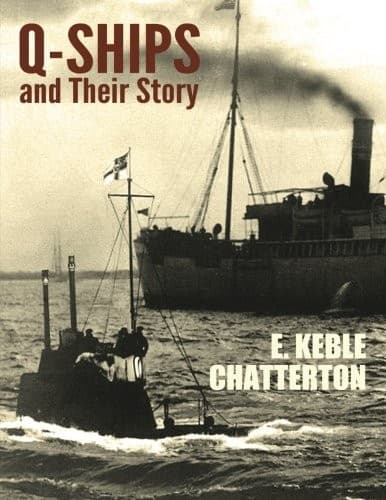
Q-Ships and Their StoryChatterton, E. Keble (Edward Keble)
History
Q-Ships and Their Story
Chatterton, E. Keble (Edward Keble)
Q-ships; World War, 1914-1918 -- Naval operations
Q-ship work was, in fact, typical of the great upheaval
which had affected the whole world.
In some cases the transition was gradual. Some officers, having come
from other ships to command sloops, found their aspirations satisfied
not even in these ships, whose work went on unceasingly—escorting all
but the fastest Atlantic liners, patrolling, minesweeping, picking up
survivors or salvaging stricken ships, or whatever duty came along.
Transferring as volunteers from sloops to sloops rebuilt as Q-ships,
they had to forget a great deal and acquire much more. One of such
officers was Lieut.-Commander W. W. Hallwright, R.N., who, after doing
very fine work as captain of one of H.M. sloops based on Queenstown,
took over command of the disguised sloop _Heather_ (Q 16). One April
day in 1917, while cruising in the Atlantic about breakfast time,
_Heather_ was suddenly attacked by a submarine, whose sixth shot killed
this keen officer, a piece of shell passing through his head whilst he
was watching the movements of the German through a peep-hole on the
starboard side of the bridge. Lieutenant W. McLeod, R.N.R., then took
command, opened fire, but the submarine dived and made off as usual.
Other Q-ship captains perished, and that is all we know. On a certain
date the ship left harbour; perhaps a couple of days later she had
reported a certain incident in a certain position. After that, silence!
Neither the ship nor any officers or crew ever returned to port, and
one could but assume that the enemy had sent them to the bottom. In
spite of all this, the number of volunteers exceeded the demand. From
retired admirals downwards they competed with each other to get to sea
in Q-ships. Bored young officers from the Grand Fleet yearning for
something exciting; ex-mercantile officers, yachtsmen, and trawler men,
they used every possible means to become acceptable, and great was
their disappointment if they were not chosen.
[Footnote 3: ‘Germany’s High Sea Fleet in the World War,’ p. 242.]
[Footnote 4: _Tulip_ was sunk by U 62, whose captain reported that she
was a very well-disguised trap, having the appearance of a medium-sized
cargo steamer. Suspicion was aroused by the way the merchant flag was
hoisted, and the fact that she appeared to have no defensive gun.]
CHAPTER XI
THE GOOD SHIP ‘PRIZE’
Public-domain text, read in full here on John Shaqi.
Reviews
Reviews
No reviews yet
Be the first to share your thoughts on this work.
Elsewhere in the archive
Join the Discussion
Join the discussion
Sign in to leave a comment or review.
Sign InorCreate an account