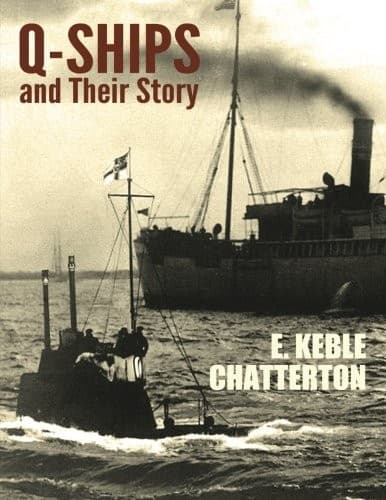
Q-Ships and Their StoryChatterton, E. Keble (Edward Keble)
History
Q-Ships and Their Story
Chatterton, E. Keble (Edward Keble)
Q-ships; World War, 1914-1918 -- Naval operations
On June 12, 1917—that is, six weeks after the previous incident, just
time enough to give leave to all the crew, get the ship refitted and
sailed to her new area—_Prize_ left Killybegs (Ireland) to cruise
to the westward of the Irish coast. At 11 a.m. on this day she was
under all sail on a N.N. W. course, doing not more than a knot through
the water, when she sighted a submarine 1-1/2 miles to the E.S.E.
proceeding slowly on the same course as _Prize_. The movements of
this submarine thereafter are worth noting. It is only reasonable to
suppose that on his return to Germany in U 93 Ziegler would give a
full description of the trap-ship which had so nearly destroyed him.
This information would, of course, be passed on to the other submarine
captains who frequented this Irish area, and we may be quite certain
that they would be on the look-out for her, anxious to revenge their
service. Now, in these modern times, and in any twenty-four hours, you
will see far more steamers of all sorts than 200-ton sailing craft: it
certainly was so during the war off the west and south-west coast of
Ireland. During the years I was on patrol there, with the exception
of quite small local fishing craft and an occasional full-rigged ship
making the land after her voyage across the Atlantic, one scarcely
ever sighted a sailing vessel of any kind. Ziegler would have reported
in effect: ‘Look out for a three-masted topsail schooner of about
200 tons. She has a bow like this..., her stern is like this..., and
her sheer is so.... You will probably find she has a dummy deckhouse
placed here...;’ and a rough sketch would afford his comrades a pretty
accurate idea. You cannot ever disguise the appearance of such a
sailing ship altogether, no matter what name you give her, nor what
colour you paint her hull. A three-masted topsail schooner is that
and nothing else, and would henceforth be regarded with the utmost
suspicion. Then, on comparing her with the sketch and examining her
with the eye of seamanlike experience, no astute submarine officer
could have had much doubt in his mind. A British officer who knew this
ship well has told me that in his opinion there was one small detail,
in respect of the wireless, which, to a careful observer, would always
give her character away. This may be so: at any rate, the following
incidents seem to indicate that the enemy were on the look-out for her
during the rest of her career, and persistently attacked her.
Public-domain text, read in full here on John Shaqi.
Reviews
Reviews
No reviews yet
Be the first to share your thoughts on this work.
Elsewhere in the archive
Join the Discussion
Join the discussion
Sign in to leave a comment or review.
Sign InorCreate an account