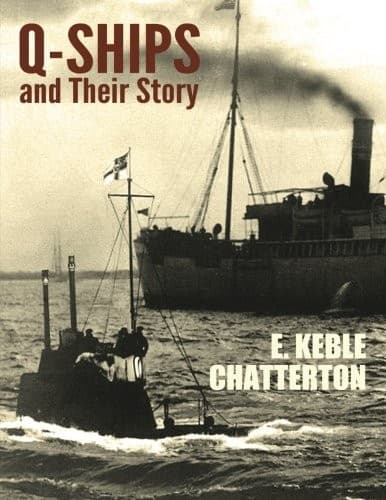
Q-Ships and Their StoryChatterton, E. Keble (Edward Keble)
History
Q-Ships and Their Story
Chatterton, E. Keble (Edward Keble)
Q-ships; World War, 1914-1918 -- Naval operations
On the occasion of June 12, as soon as the submarine came to the
surface and opened fire, _Prize_ as usual, after the necessary
intentional bungling, sent away her boat, which took up a position half
a mile away on the starboard bow. The enemy kept on firing, and at
11.30 the schooner was hit twice, so three minutes later, as the enemy
was turning away to increase the range, Sanders ordered the screens to
be lowered, and opened fire from both starboard guns at 1,800 yards.
One shell seemed to hit, and the enemy immediately dived. But two hours
later a submarine was seen on the surface 4 miles away on the starboard
quarter, and remained in sight for a quarter of an hour. Then next
morning at 6.30 a submarine was sighted stopped, 1-1/2 miles ahead
on the surface. Five minutes later he dived, but came up after four
minutes 1,500 yards off on the starboard bow. At 6.43 he again dived,
and was not seen again. Probably each of these three appearances was
the same submarine. On the first he was repulsed, on the second he
would have a perfect opportunity of making a detailed sketch, on the
third he may have been intending to attack by torpedo, but the westerly
swell from the Atlantic possibly interfered with accurate firing. But,
apart from all surmise, it is absolutely evident that the enemy was
able to obtain a picture of the schooner, which beyond all doubt would
establish her identity on a future occasion. The importance of this
will presently be seen.
For this action of June 12 Lieut.-Commander Sanders was given a D.S.O.
to wear with his V.C. He had had a very trying time. When, at 11.30,
the German shells had hit, the falls of the port davit had been shot
away, and another shot had struck the ship on the starboard side
amidships just on the top of the sheer strake plate. This shell had
exploded and caused the ship to leak. Lieut.-Commander Sanders, who
was lying concealed between the mast and the hatch, put up his arms
to shield his face from the burst fragments and so received a piece
of shell in his right arm above the wrist. In addition, the force
of the explosion knocked him over and hurled him to the other side
of the deck, where he was picked up by Skipper Mead. In spite of the
pain and the shock, Sanders was just sufficiently conscious to give
the order ‘Action’ at 11.33, when screens were downed, White Ensign
run up, and fire was returned. The schooner came back to her base,
her gallant captain recovered from his wound, and two months later we
find her operating in the Atlantic again to the north-west of the N.W.
Irish coast. On this occasion she was cruising with one of our D-class
submarines, the idea being that when the enemy came along _Prize_ would
be attacked and heave-to in the customary manner, while the British
submarine would stealthily make for the enemy and torpedo him whilst,
so to speak, he was not looking.
Public-domain text, read in full here on John Shaqi.
Reviews
Reviews
No reviews yet
Be the first to share your thoughts on this work.
Elsewhere in the archive
Join the Discussion
Join the discussion
Sign in to leave a comment or review.
Sign InorCreate an account