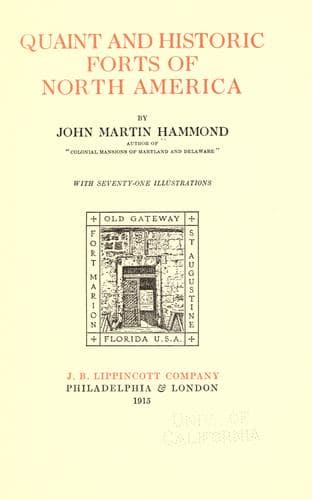
Quaint and Historic Forts of North AmericaHammond, John Martin
History
Quaint and Historic Forts of North America
Hammond, John Martin
Fortification -- North America; Fortification -- United States; Historic buildings -- United States
There is to be seen the casemate in which Jefferson Davis,
president of the Confederate States, was confined after the working
out of the destiny of the Lost Cause. It is not different from its
neighbors, and is an inconspicuous little compartment in a wall
with an ornamental little two-post doorway and one window. Many
curious visitors stop before it.
Old Point Comfort and all of this section of the lower Chesapeake
have seen many strange visitors and cargoes in the Past. Doughty
old Captain John Smith came to Hampton Roads and wrote about what
he saw with that wealth of picturesque detail which those old
chroniclers loved to pour forth. The name Point Comfort itself
came from the circumstance that Smith was cast into this Hampton
Roads on the wings of a storm at sea and that he hailed the first
strip of solid land that he saw as a comfort, indeed. At an early
period a settlement was made here, as a subsidiary of the Jamestown
colony, and, as early as 1611, a fort was built on the point as
a defence against Indians and freebooting marauders of buccaneer
type. The fort was armed and known as Fort Algernon, in honor of
Lord Algernon Percie, one of the directors of the Virginia Company.
The greatest fort of the country was once called Algernon!
This little fortification was not of long life, however. It was
maintained for a few years by the Jamestown colony but went into
decay after the failure of its parent. The strategic value of the
Point as a place for defence was not lost sight of, however, in any
succeeding generation, though the place was not called into service
for many years.
[Illustration:
By courtesy of the War Department
FIRE!!!
Showing shells just leaving mortars, Fort Monroe, Va. (This
remarkable photograph was taken with modern high speed appatratus
by the Corps of Enlisted Specialists stationed at this post.)]
The foundations of Fortress Monroe were laid in 1819, and the
works were carried forward actively for ten years. The plans were
drawn by the famous Bernard, one-time aide-de-camp of the first
Napoleon, and one of his leading engineers. It was Bernard’s
ambition to construct in the United States (he came to the
United States in 1816 and immediately entered the employ of the
government) one great fortress like the works of Antwerp, in the
fortification of which he had a large share. Fort Monroe, named
in honor of the president who did so much to make sure that the
coast defences of the country should be adequately founded, was the
result of this vision.
It is to be seen that the life of the present fortification begins
after the War of 1812, but the military history of the vicinity of
Fort Monroe prior to that time is full of interest.
Public-domain text, read in full here on John Shaqi.
Reviews
Reviews
No reviews yet
Be the first to share your thoughts on this work.
Elsewhere in the archive
Join the Discussion
Join the discussion
Sign in to leave a comment or review.
Sign InorCreate an account