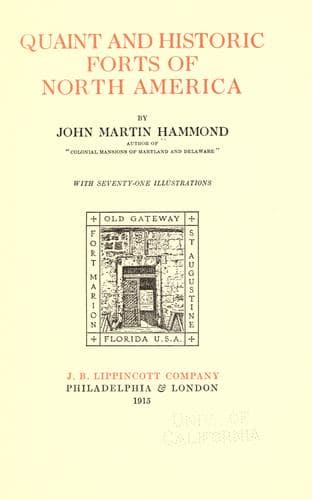
Quaint and Historic Forts of North AmericaHammond, John Martin
History
Quaint and Historic Forts of North America
Hammond, John Martin
Fortification -- North America; Fortification -- United States; Historic buildings -- United States
During the Revolution the mouth of the Chesapeake was guarded by
British cruisers and a rigorous blockade was maintained. Despite
this, during the war no less than 248 privateers were fitted out in
the waters of the Chesapeake and managed to gain the high seas by
eluding the vigilance of the patrol beyond the capes.
In 1779 General Leslie sailed from New York with 3000 of His
Majesty’s troopers to land upon the peninsula not far from the site
of Fort Monroe and there to await orders from Lord Cornwallis, who
was in North Carolina. He entered Hampton Roads and took Norfolk
and Portsmouth, fortifying the latter place as a base for future
operations. After some weeks of inactivity, he re-embarked and
sailed to reinforce Cornwallis at Charleston. In the following year
Clinton ordered the traitor Arnold with 50 sail and 1600 soldiers
to replace Leslie.
The Arnold expedition proceeded up the James River in 1781 and set
the torch to the public buildings of Richmond. After pillaging
Petersburg, it returned to Portsmouth and threw up strong
intrenchments. Lafayette attempted to stay this destroying band
but had not force enough of his own and did not receive expected
reinforcement. The fleet which had been sent to augment his numbers
was engaged by the British under Admiral Arbuthnot off the capes
and compelled, after a hot engagement, to withdraw to Newport. The
English thus retained their hold on Hampton Roads and were enabled
to send additional forces to General Arnold under General Phillips.
In April the combined forces under Arnold moved again up the James
River, burning and pillaging.
Cornwallis occupied Portsmouth shortly after this, but soon again
moved to Yorktown, where he threw up huge intrenchments, the
outlines of which are plainly discernible at the present day. In
September, 1781, the French under Comte de Grasse were successful
in entering the Chesapeake to co-operate with Washington, Lafayette
and Rochambeau. The British fleet under Admiral Graves sturdily
contested the capes, but was forced to surrender the hold which it
had maintained so effectively. In the ensuing month occurred the
historic surrender of Cornwallis.
[Illustration: CASEMATES OF FORT MONROE, AS THEY WERE DURING THE
CIVIL WAR]
During the War of 1812, a British order in council declared the
Chesapeake to be in a state of blockade, and in 1813 Rear-Admiral
Cockburn of His Majesty’s navy was sent to Lynnhaven Bay, near
Norfolk. The Americans had a large flotilla in Hampton Roads, and
had constructed Forts Norfolk and Nelson on the Elizabeth River
near Norfolk and had thrown up intrenchments on Craney Island,
these dispositions all being under the direction of Brigadier
General Robert B. Taylor.
Public-domain text, read in full here on John Shaqi.
Reviews
Reviews
No reviews yet
Be the first to share your thoughts on this work.
Elsewhere in the archive
Join the Discussion
Join the discussion
Sign in to leave a comment or review.
Sign InorCreate an account