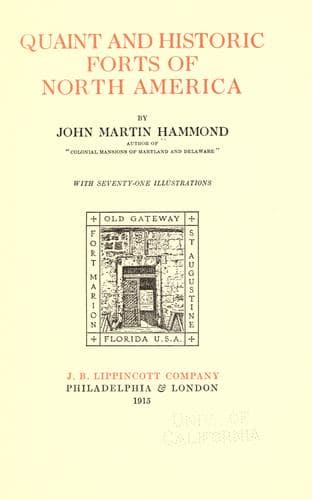
Quaint and Historic Forts of North AmericaHammond, John Martin
History
Quaint and Historic Forts of North America
Hammond, John Martin
Fortification -- North America; Fortification -- United States; Historic buildings -- United States
Ascending to the parapet of the fort by means of one of the
twisting iron stairs which are to be found at each angle, or by
the broad stone stairs adjacent to the habitable casemates, one
has a wide view of land and sea. To the east lies the mouth of the
Savannah River where this stream joins the Atlantic Ocean. In this
direction, too, can be seen long, low, sandy Tybee Point, where
Fort Screven, the modern defensive work, lies. To the south are
marshes and in the distance the gleam of the river up which the
Union forces brought their cannon to attack Fort Pulaski in 1862.
To the north and west--more marshes.
The island on which Fort Pulaski is situated was acquired by
the government in 1830 by purchase from Alexander Telfair and
sisters (an old and wealthy Savannah family) and the title of
the government thereto for the purposes of a fortification was
confirmed by the State of Georgia by act December 27, 1845. The
entire reservation occupies about 150 acres.
The site for the fort was selected by Major General Babcock, United
States Corps of Engineers, and work was begun in 1831 under the
direction of Major General Mansfield. Sixteen years passed before
its mighty walls, containing thirteen millions of bricks, were
completed. The name Pulaski was given to the fort in honor of Count
Casimir Pulaski, the Polish patriot who lost his life in the siege
of Savannah by the Americans during the Revolution, the scene of
this sad event being the Spring Hill redoubt near the site of the
present Central of Georgia railway station.
The military history of Fort Pulaski does not cover a long period
of time. When, in December, 1860, the news reached Savannah of the
removal of Major Anderson, in command of the United States forces
in Charleston Harbor, from Fort Moultrie to Fort Sumter, there
was an open expression of opinion that Georgia should forestall
such occupation of the forts on her coast by the forces of the
Federal government; and when, on January 2, 1861, it became known
that Governor Brown had ordered the seizure and occupation of Fort
Pulaski by the military under the command of Colonel A. R. Lawton
on the following day, the city was wild with enthusiasm.
Says Adelaide Wilson in her delightful history of Savannah:
Public-domain text, read in full here on John Shaqi.
Reviews
Reviews
No reviews yet
Be the first to share your thoughts on this work.
Elsewhere in the archive
Join the Discussion
Join the discussion
Sign in to leave a comment or review.
Sign InorCreate an account