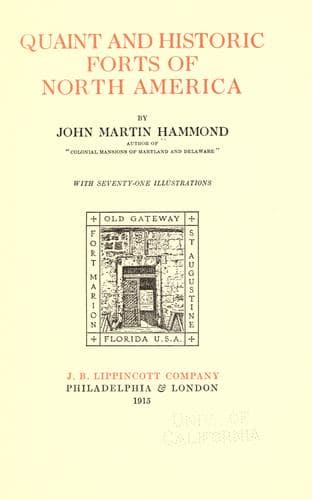
Quaint and Historic Forts of North AmericaHammond, John Martin
History
Quaint and Historic Forts of North America
Hammond, John Martin
Fortification -- North America; Fortification -- United States; Historic buildings -- United States
Mobile Bay, that pear-shaped body of water, with its far-reaching
system of water tributaries, has been a scene of settlement and
fortification since the early days of French attempts at settlement
in the New World. There was, to begin with, Fort Louis de la
Mobile, which protected the infant first settlement of Mobile,
precursor of the city of to-day. In various guises Fort Louis
passed from one to another of the different races of men with which
the history of Mobile Bay is associated. Then there are the forts
placed on the islands at the mouth of Mobile Bay and the forts at
the head of the bay where the big rivers flow in. Finally there is
Fort Morgan (Fort Bowyer to begin with) which occupies the point of
that long, thin peninsula of land which forms the southern boundary
of Mobile Bay, dividing its waters from the waters of the Gulf of
Mexico.
Fort Morgan to-day is in ruins and has never been thoroughly
rebuilt since its capitulation to Farragut in one of the hottest
battles of the Civil War. The governmental reservation of land
on which the works are situated contains about 500 acres and is
occupied, as well, by modern defences. The view from the point on
which the old fort is situated gives a wide prospect of blue water
and sky. Across the ship channel is historic Dauphine Island, on
which Fort Morgan’s sister fort, Fort Gaines, was situated, and
where the government to-day maintains extensive batteries. To the
right are the waters of Mobile Bay, with the smoke of the city
thirty miles to the north. To the left are the sunny waves of the
Gulf.
The first that we hear of Mobile Point as a place of fortification
was in 1812, when the Spanish evacuated Mobile. General Wilkinson,
in command of the United States forces in the southwest, put nine
guns as a battery on Mobile Point and made his way on up to the
city, where he commenced to fortify the perdido. Subsequently
Mobile Point appealed to him as a better place for defensive works
than a spot so far up the bay, and he placed a fortification here,
which was called Fort Bowyer in honor of Lieutenant-Colonel Bowyer.
The next occupant of Fort Bowyer was a more picturesque personage
than General Wilkinson, none other than Andrew Jackson. Upon his
retirement from Pensacola in 1814, Jackson stopped at Fort Bowyer
and left a force there of 130 men under the leadership of Major
William Lawrence. On September 12 the British appeared before the
fort with land and naval strength and demanded the surrender of the
little structure. Major Lawrence refused to surrender.
Public-domain text, read in full here on John Shaqi.
Reviews
Reviews
No reviews yet
Be the first to share your thoughts on this work.
Elsewhere in the archive
Join the Discussion
Join the discussion
Sign in to leave a comment or review.
Sign InorCreate an account