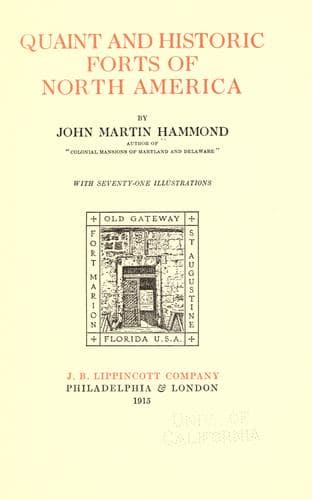
Quaint and Historic Forts of North AmericaHammond, John Martin
History
Quaint and Historic Forts of North America
Hammond, John Martin
Fortification -- North America; Fortification -- United States; Historic buildings -- United States
The reservation of Fort Jackson contains 557.6 acres and that of
Fort St. Philip 1108.85 acres. The reservations consist entirely of
swamp lands, during season of high water being almost completely
inundated. Those portions containing the forts, quarters and
other buildings are leveed on all sides, but notwithstanding the
protection thus afforded there are times when the water rises so
high as to become a source of great inconvenience in going about.
This is especially the case when rain is added to the water which
percolates through the levees.
Any account of Fort Jackson would be incomplete without allusion
to its alligators. These reptiles constitute one of the principal
objects of interest to visitors and may be seen in numbers floating
in the moats or basking on shore in the sunlight. They are from
five to fifteen feet in length and possess great strength. It was
customary to feed them with bread and crackers from the bridges
over the moats, calling them up by whistling, and from frequent
occurrence of this act they seemed to become accustomed to the
signal and responded to it just as might dogs.
The rattlesnakes of the vicinity are numerous and formidable. One
was caught here measuring 11½ feet and having 27 rattles. Black
snakes are large but rare. Moccasins, of which there are two
varieties, attain a large size and are frequently very venomous.
The mosquitoes constitute a serious obstacle to the enjoyment of
life to the infrequent garrisons at this post, for they not only
ply their calling with great diligence during the night but in
summer are equally zealous throughout the day. Various expedients
are adopted to avoid and drive them away. The smudge is brought
into frequent and useful requisition. Gloves are worn and covering
of mosquito netting is frequently used to protect the neck and
head.
FORT SNELLING
NEAR ST. PAUL--MINNESOTA
The historic post of Fort Snelling, Minnesota, for more than a
generation after its establishment, in 1819, the most remote
western outpost of the United States, is situated at the confluence
of the Minnesota and Mississippi Rivers, eight miles southeast
of Minneapolis by river and six miles from St. Paul. It lies in
a region of rare natural beauty, in the vicinity of the Falls of
Minnehaha, Bridal Veil Falls, and other points locally notable
and is, itself, no mean attraction to the many visitors who are
attracted to the locality every year. The old fort standing on its
high bluff at the headwaters of America’s greatest river is a most
picturesque object.
[Illustration:
Copyright, Detroit Publishing Co.
OLD STONE TOWER AT FORT SNELLING, NEAR ST. PAUL, MINN.]
Public-domain text, read in full here on John Shaqi.
Reviews
Reviews
No reviews yet
Be the first to share your thoughts on this work.
Elsewhere in the archive
Join the Discussion
Join the discussion
Sign in to leave a comment or review.
Sign InorCreate an account