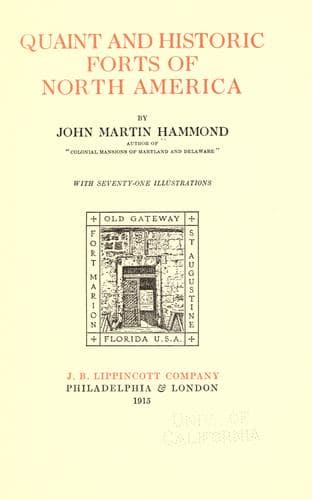
Quaint and Historic Forts of North AmericaHammond, John Martin
History
Quaint and Historic Forts of North America
Hammond, John Martin
Fortification -- North America; Fortification -- United States; Historic buildings -- United States
The reservation of Fort Snelling contains 1,531 acres, though
originally this tract was much larger than now. The fort structure
which one sees from the river is an irregularly shaped bastioned
wall conforming in outline to the high plateau of land upon which
it is situated. It occupies the extreme end of the point of land
formed by the juncture of the two rivers, and on the Mississippi
side the bluff upon which the fort is situated descends abruptly
to the water, the river there running almost in a canyon. On the
Minnesota side the slope is more gradual and ends in a low marshy
flat which extends from one-third to one-half a mile and is
frequently submerged during high water. The altitude of the post
plateau above the river is 300 feet.
The establishment of Fort Snelling was one of the fruits of the
work of Lieutenant Z. M. Pike, the first American to explore and
chart the peak which bears his name. In 1805 this officer was in
command of an exploring expedition and held a conference with the
Sioux Indians on an island at the mouth of the Minnesota River
which now bears his name. He secured from the Indians for military
purposes a strip of land nine miles on each side of the Mississippi
River and extending from the conference island to the Falls of St.
Anthony, near which Fort Snelling is.
It is to be remembered that in 1805 the settlement of the American
nation did not extend beyond the Mississippi River. The country
west of Lake Michigan and on the headwaters of the Mississippi
River, though a part of the United States, thanks largely to George
Rogers Clark, was in a state of nature with only the trails of
Indians and traders and the remains of little French settlements as
the foundation for the civilization which was to grow up within it.
The privileges which Lieutenant Pike secured from the red men
were not immediately taken advantage of by the United States
authorities. Time passed and the War of 1812 with England gave the
War Department of this country quite as much as it could take
care of. Finally, in 1819, Lieutenant Colonel Henry Leavenworth,
of the Fifth United States Infantry, was sent with his regiment to
locate a fort upon the reserve selected by Lieutenant Pike. Colonel
Leavenworth reached the headwaters of the Mississippi without
incident and rendered his first monthly report in September, 1819.
Scurvy broke out now among the troops and this, added to the
natural inclemencies of the climate here in winter, prevented any
work being done until the spring of 1820. In May, 1820, Colonel
Leavenworth moved his troops to a point on the west bank of the
Mississippi River, about a mile and a half above the present
location of Fort Snelling. The site chosen by him for the fort was
the present military cemetery. He made preparations to commence the
work, but Colonel Josiah Snelling assumed command in August and
selected the location where the fort now stands.
Public-domain text, read in full here on John Shaqi.
Reviews
Reviews
No reviews yet
Be the first to share your thoughts on this work.
Elsewhere in the archive
Join the Discussion
Join the discussion
Sign in to leave a comment or review.
Sign InorCreate an account